Have you ever tried to solve a tricky problem and wished you had a team to bounce ideas off of? Maybe one person to do the legwork, another to analyze the data, and a third to make the final call?
It turns out that’s a pretty powerful way to get things done. And surprisingly, it’s an approach we can use to build smarter, more effective AI.
Today, we’re going to pull back the curtain on a fascinating corner of AI called multi-agent reinforcement learning. Forget the dense academic papers and confusing jargon. We’re going to build a tiny AI team from scratch, right here, and watch them learn to solve a maze.
Think of it as a fun weekend project. By the end, you’ll not only understand the theory but you'll have a real feel for how these systems actually think, collaborate, and get smarter over time. Let’s get our hands dirty.
First, We Need a Playground: The Grid World
Before our AI agents can learn anything, they need a world to live in. We can’t just drop them into the void, right? So, we'll build a simple "Grid World."
Imagine a basic checkerboard. That’s our world.
- The Agent: A single red square, our little hero.
- The Goal: A green square on the opposite corner.
- Obstacles: A few black squares scattered around, like walls in a maze.
Our agent starts at [0, 0] and its mission, should it choose to accept it, is to find the green square at [7, 7]. It’s simple, visual, and perfect for watching our AI learn the ropes. We'll set up the basic rules: the size of the board, where the agent starts, where the goal is, and a few random obstacles to make things interesting.
This little world is more than just a map; it's a dynamic environment. We need to define what happens when our agent takes a step. If it bumps into a wall or an obstacle, that’s a no-go. If it reaches the goal, hooray! And if it just wanders around for too long, we’ll call it a day and start a new attempt.
We also need a reward system. Think of it like training a puppy.
- Reach the goal: Get a big treat (+10 points!).
- Hit a wall or obstacle: A small penalty (-1 point).
- Step on a new, unexplored square: A tiny treat (+0.5 points) to encourage curiosity.
- Just moving around: A very small cost (-0.1 points) to encourage efficiency.
This system of rewards and penalties is the core of reinforcement learning. The agent doesn't know the "right" path. It just knows it wants to get the most treats possible. Our whole job is to watch it figure out how.
Meet the Team: A Trio of Specialized AI Agents
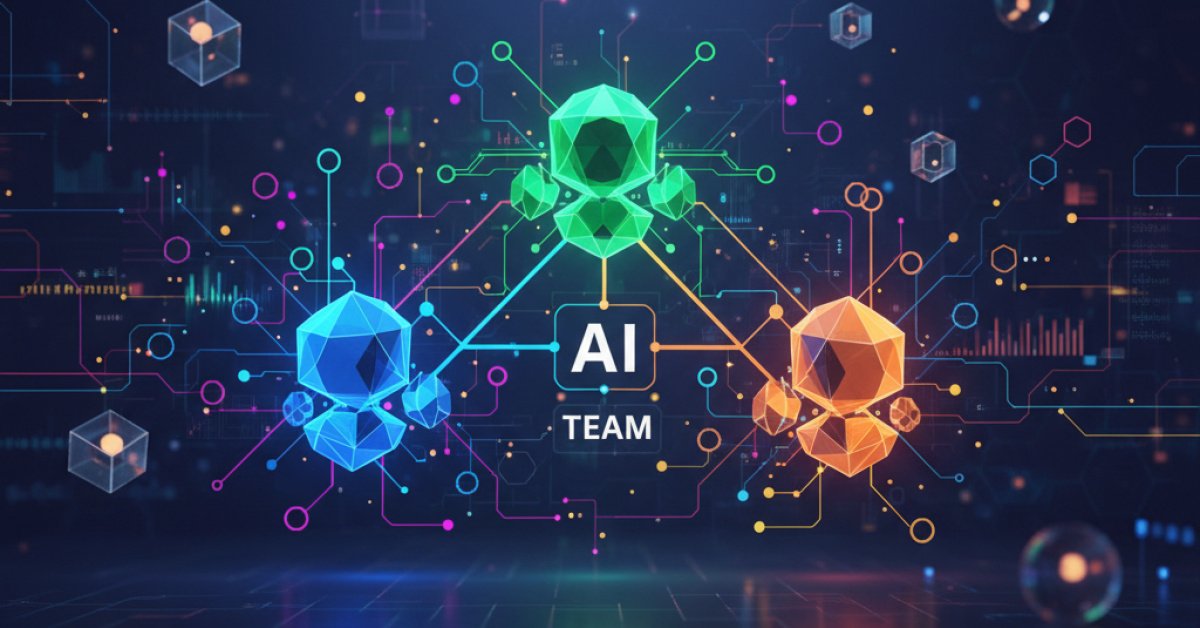
Okay, our world is ready. Now for the fun part: creating our AI team. A single agent could probably solve this maze eventually, but it might get stuck in loops or make inefficient choices. By creating a team with specialized roles, we can build a much smarter system.
Let's meet the crew.
1. The Action Agent: The Rookie on the Ground
This is our "doer." The Action Agent is the one actually moving around the grid. It’s driven by a classic reinforcement learning algorithm (in this case, Q-learning), but you don’t need to get bogged down in the math.
Here’s the gist of how it thinks:
It maintains a little cheat sheet (a "Q-table") that keeps track of how good each move is from any given square. At first, this cheat sheet is blank. The agent has no idea what to do.
So, it operates on a simple principle called "epsilon-greedy." Most of the time, it will look at its cheat sheet and choose the move it thinks is best (exploitation). But sometimes, with a certain probability (that’s the "epsilon"), it will throw caution to the wind and try a random move (exploration).
Why? Because exploration is how it discovers new, potentially better paths! If it only ever did what it thought was best, it might miss a brilliant shortcut just around the corner. The Action Agent’s job is to be brave, make mistakes, and update its cheat sheet based on the rewards it gets. It’s the guts of the operation.
2. The Tool Agent: The Analyst in the Sky
While the Action Agent is busy bumping into walls, the Tool Agent is watching from above. This agent doesn't take any actions itself. Its job is to analyze the situation and provide helpful feedback.
Think of it as the mission controller, looking at the bigger picture. It asks questions like:
- "Are we just wandering, or are we making progress toward the goal?"
- "Have we been getting a lot of negative rewards recently? Maybe our current strategy isn't working."
- "Wow, we're really close to the goal! We should probably stop exploring randomly and just head for the finish line."
- "Uh-oh, we're cornered with only one or two moves available. Let's be careful."
The Tool Agent translates these observations into simple, actionable suggestions. It’s the strategic brain of the team, offering a second opinion based on data and heuristics.
3. The Supervisor Agent: The Team Lead Who Makes the Call
Finally, we have the Supervisor. This agent gets the proposed move from the Action Agent ("I think we should go left!") and the strategic advice from the Tool Agent ("We're close to the goal, prioritize moving toward it!").
The Supervisor’s job is to make the final decision.
Most of the time, it will probably trust the Action Agent. After all, it's the one learning on the ground. But if the Tool Agent raises a critical point, the Supervisor can step in and override the decision.
For example, if the Action Agent wants to explore a random path but the Tool Agent points out that the goal is just one step to the right, the Supervisor will say, "Thanks for the input, rookie, but we're going right."
This creates a beautiful system of checks and balances. We have the learning and curiosity of the Action Agent, the strategic oversight of the Tool Agent, and the final, goal-oriented judgment of the Supervisor.
The Training Montage: Putting It All Together
Now we have our world and our team. It's time to let them run. We'll put them through a series of "episodes." Each episode is one full attempt to get from the start to the goal.
Here’s what a single step in an episode looks like:
- The Action Agent looks at the board and proposes a move based on its Q-table and its desire to explore.
- The Tool Agent analyzes the current situation and offers suggestions.
- The Supervisor Agent takes both inputs and makes the final decision on which way to move.
- The agent moves, the environment gives it a reward or penalty, and we see what happens.
- The Action Agent takes that feedback and updates its internal cheat sheet, learning from the outcome.
We repeat this process over and over.
In the first few episodes, it's chaos. The agent wanders aimlessly, hits a lot of walls, and takes forever to find the goal (if it finds it at all). It looks pretty dumb, honestly.
But then, something magical starts to happen.
As the Action Agent's cheat sheet gets more accurate, it starts making better choices. The Tool Agent's suggestions help it avoid getting stuck in loops. The Supervisor ensures it stays focused when it matters most.
After just a handful of episodes, you can see the change. The path becomes more direct. The agent confidently navigates around obstacles. The number of steps it takes to reach the goal drops dramatically. It's literally learning before our eyes.
So, Why Does This Matter?
Okay, teaching a red square to navigate a grid is a fun little puzzle. But the principle here is incredibly powerful.
This multi-agent approach mirrors how complex, intelligent decisions are often made in the real world. You don’t have one monolithic genius solving everything. You have a team of specialists, each with their own role, collaborating to produce a result that’s greater than the sum of its parts.
By breaking down a complex problem (like navigating a maze) into simpler roles—doing, analyzing, and supervising—we can build AI systems that are more robust, interpretable, and effective. We can see why the system made a certain decision because we can look at the individual contributions of each agent.
So next time you hear about a sophisticated AI, remember our little team. It might not be a single, super-intelligent brain at work, but rather a well-coordinated group of simpler agents, all working together to find the smartest path forward.