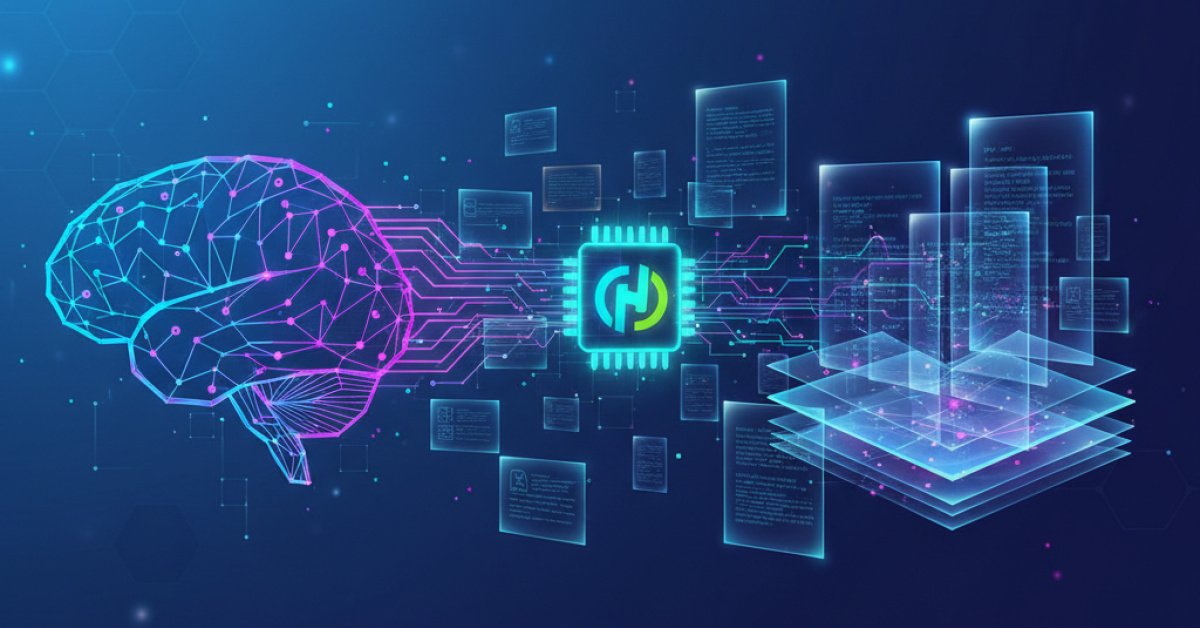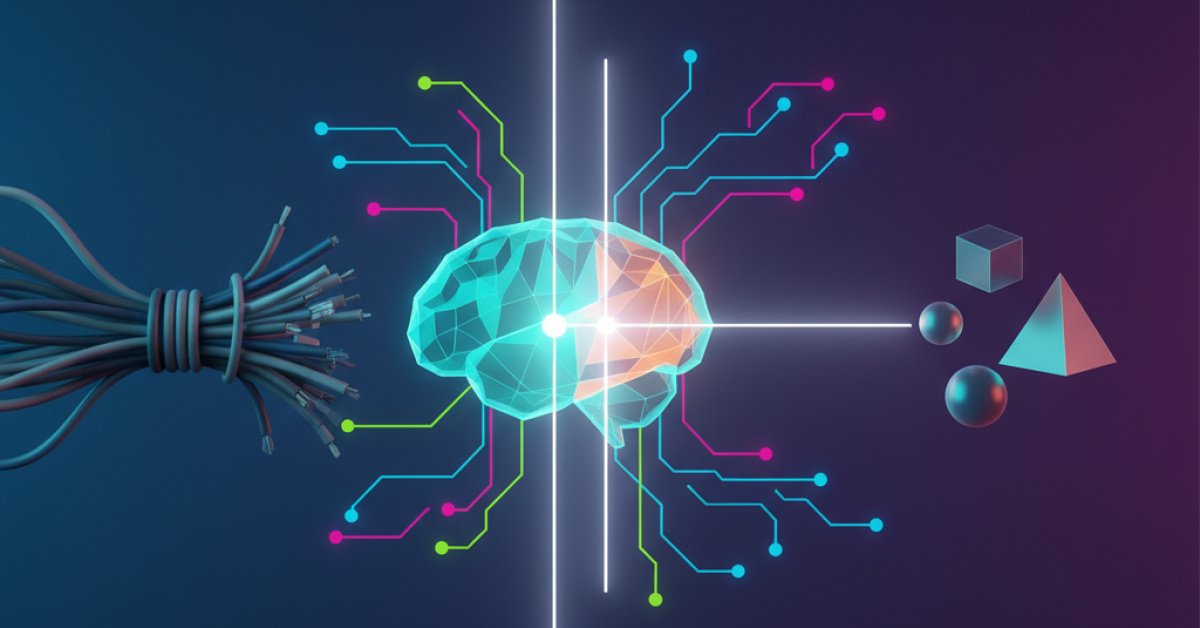
Have you ever tried to figure out how a complex piece of software works without any documentation? It's a nightmare, right? You click a button, something happens, but the "why" and "how" are a complete mystery. For years, that's been our relationship with the most powerful AI models. They're incredible, but they're also "black boxes." We can see the input and the output, but the logic in between is a tangled mess.
This is a huge problem. As we start trusting these models with everything from writing our code to assisting in safety-critical systems, not knowing how they arrive at an answer is, frankly, a bit terrifying.
But what if we could untangle that mess? What if we could actually trace the specific path of a decision through an AI's neural network, like following a single colored wire in a massive, complex circuit board? That's the promise of some fascinating new research from OpenAI, and it might just be the key to building AI we can truly understand and trust.
The Spaghetti Problem in Most AI Models
Let's get on the same page about why this is so hard in the first place. Most transformer models, the architecture behind things like GPT, are what we call "dense."
Imagine a giant plate of spaghetti. Every single noodle is touching a dozen other noodles. If you try to follow one strand from one side of the plate to the other, it's basically impossible. It disappears into a chaotic, intertwined mess.
That's a dense neural network. Every "neuron" in one layer is connected to a huge number of neurons in the next. Information gets spread out, mixed together, and stored in complex, overlapping patterns (a concept researchers call "superposition"). This makes them powerful, but it also makes tracing a single line of reasoning a fool's errand.
OpenAI’s Fix: Forcing the AI to Be a Minimalist
So, how do you solve the spaghetti problem? You don't get a bigger fork; you just use way, way fewer noodles.
This is the core idea behind OpenAI's new approach. Instead of trying to interpret a messy, dense model after the fact, they've decided to build the tidiness in from the very beginning. They train a GPT-2-style model with a simple but radical rule: you can't use all your connections.
Here’s how it works:
- The model learns a little bit, just like any other AI.
- Then, the researchers step in and, like an aggressive gardener, prune the network. They look at all the connections (the "weights") between neurons and set the vast majority of them to zero.
- Only the strongest, most important connections get to stay.
They repeat this process over and over during training. The model is constantly being forced to find the most efficient pathways to solve problems, because it simply doesn't have the luxury of a billion messy connections.
How extreme is this? In their most sparse models, only about 1 in every 1,000 connections is active. The rest are zero. The result is an incredibly "thin" network. The spaghetti plate is gone, and in its place is a clean, simple diagram where the pathways are obvious.
Measuring "Understanding": The Jenga Test
Of course, saying a model "looks simpler" isn't very scientific. The OpenAI team needed a way to prove that these sparse models are genuinely easier to understand.
So, they designed a series of simple tests. They gave the model small, algorithmic coding tasks in Python, like predicting the next piece of code. Think of it like teaching a kid a very specific rule.
Here are a couple of examples:
- The Quote Game: If a line of Python code starts a string with a
"(a double quote), it must end with one. If it starts with a'(a single quote), it must end with that. The model has to predict the correct closing quote. - Set or String?: In Python, you add an item to a
setwith.add()but you add to astringwith+=. The model has to look at how a variable was created and choose the right operator.
For each of these tasks, they went looking for the "circuit"—the smallest possible group of neurons and connections that could successfully perform the task.
Think of it like a game of Jenga. The full model is the tower. They start removing blocks (pruning neurons and connections) one by one. Their goal is to find the absolute minimum number of blocks required to keep the tower standing. That tiny, essential structure is the circuit for that specific behavior. The complexity of that circuit—basically, how many connections it has—became their core metric for interpretability.
A Real Circuit, Mapped and Understood
This is where it gets really cool. For the quote-matching task, they didn't just find a smaller circuit; they found one they could fully reverse-engineer and explain in plain English.
Here’s the step-by-step logic the AI learned:
- The Detector: An early neuron in the network acts as a "quote detector." Its only job is to fire up when it sees any kind of quote character, single or double.
- The Classifier: A second neuron acts as a "quote type classifier." It figures out which kind of quote the detector found.
- The Messenger: A later component, called an attention head, uses the signals from these two neurons. It acts like a messenger, looking back to the position of the opening quote, reading its type, and "copying" that information to the end of the string to place the correct closing quote.
That's it. A simple, three-step process. This tiny circuit of just a few neurons and a single attention head was all the model needed. When the researchers isolated this circuit, it could still do the task perfectly. When they removed it, the model failed completely.
It was both sufficient (it works on its own) and necessary (the model can't do it without it). For the first time, we're not just guessing how the AI thinks; we're reading the schematic.
What This Means for the Future of AI
For more complex behaviors, the circuits are still a bit bigger and harder to fully map out. But even in those cases, the circuits found in these sparse models are drastically smaller and more manageable than anything we could hope to extract from a traditional dense model.
When comparing models with similar performance on a task, the sparse models produced circuits that were, on average, 16 times smaller.
This is a huge deal. It points to a fundamental trade-off we can now consciously make: we can choose to build models that are slightly less capable in raw performance but are massively more transparent. And in a world where AI is becoming more powerful by the day, that feels like an incredibly smart trade to make.
This research shifts our perspective. Interpretability isn't just something we hope to do after an AI is built; it's a feature we can design for from the ground up. It’s a pragmatic, engineering-led step toward AI safety and debugging.
We're still a long way from being able to map out every thought in a massive model like GPT-4. But this is a critical first step. It's the beginning of turning these mysterious black boxes into glass boxes, where we can finally see what's going on inside. And that’s how we build a future with AI that we can not only use, but genuinely understand.