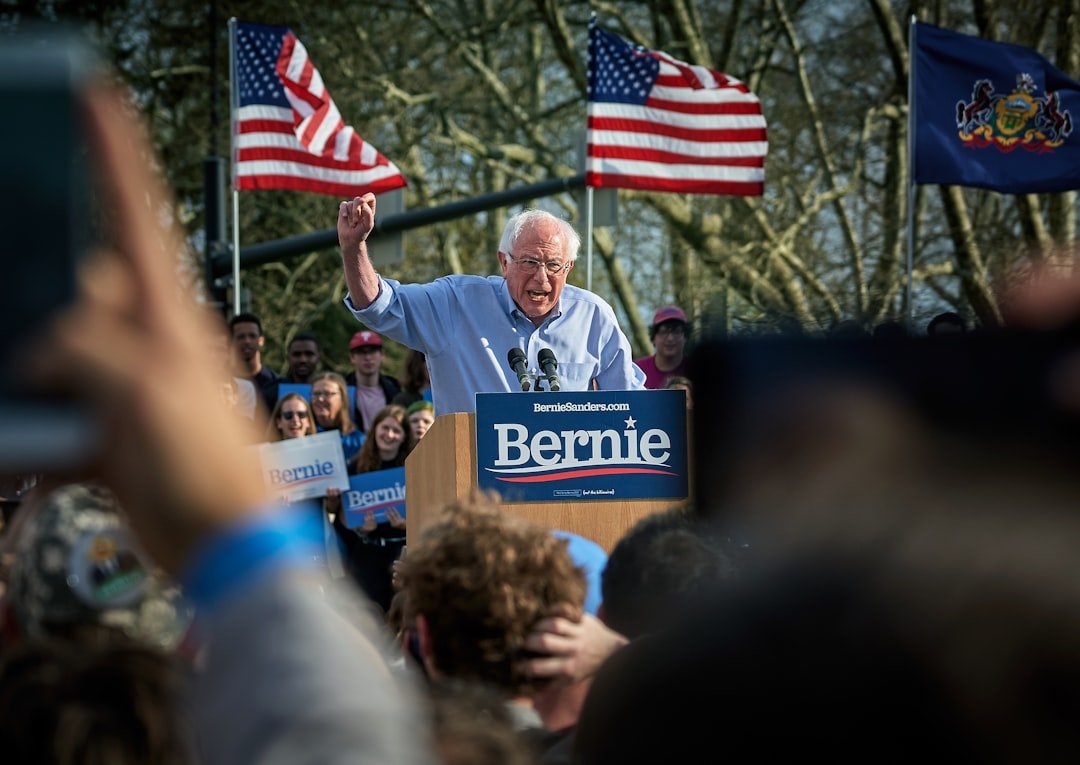
It feels like a strange thing to say in a tech blog, but let's talk about Bernie Sanders for a minute.
I know, I know. Stick with me here. For most of us in the tech world, he’s a figure who seems to exist in a completely different universe—one of political rallies and stump speeches, not product launches and AI ethics boards. But something fascinating is happening. The core message he’s been shouting from the rooftops for decades is suddenly, and powerfully, intersecting with our world of code, algorithms, and venture capital.
For as long as I can remember, Sanders has been the guy with the same unwavering argument: a tiny handful of incredibly wealthy people holding too much power is a threat to everyone else. For years, that argument was aimed at Wall Street and corporate behemoths. But now? He’s betting that the public’s growing unease with Big Tech, its billionaire founders, and the wild, unchecked sprint of AI is about to hit a boiling point.
And honestly, you have to admit, he might be onto something.
It's Not a New Tune, Just a Louder Amp
Let's be clear: Bernie Sanders didn't just wake up yesterday and decide to take on Silicon Valley. This is the same song he's been singing for 40 years. His core belief has always been that extreme economic inequality corrodes democracy. He’s argued that when a few people have that much money and control, they get to write the rules, and those rules usually benefit… well, them.
Think of it like a long-running TV show. The plot has always been the same—the struggle between the ultra-rich and everybody else. The only thing that’s changed is the setting and the characters.
In the '80s and '90s, the villains were corporate raiders and Wall Street bankers. Today, the main characters are tech founders in hoodies and jeans, but the power they wield makes the old guard look almost quaint. The concentration of wealth he's been warning about hasn't just continued; it's been put on hyper-speed by the digital revolution.
So, How Did Big Tech Become the New Wall Street?
It’s a fair question. For a long time, tech was seen as the great equalizer, a force for democratization. And in some ways, it was. But along the way, something shifted. A few companies grew into giants, and their founders became richer than kings of old.
What Sanders sees—and what a lot of us are starting to feel in our guts—is that this isn't just about a few people getting lucky. It's about a system that funnels wealth and power upwards at an astonishing rate.
Consider this:
- Winner-Take-All Markets: The internet created platforms where the network effect is everything. The biggest social network gets bigger because everyone is already there. The biggest search engine gets better because it has the most data. This naturally leads to monopolies or duopolies.
- Data as the New Oil: These companies aren't just selling products; they're collecting unimaginable amounts of our data, which has become one of the most valuable resources on the planet.
- The Power of Platforms: They don't just compete in the market; they are the market. They control the app stores, the ad networks, and the cloud infrastructure that other businesses depend on to survive.
When a handful of CEOs can make decisions that affect billions of people, from what news we see to which small businesses succeed, you’re no longer just talking about economics. You're talking about a new kind of governance, one that we never voted for. That’s the exact scenario Sanders has been describing for decades, just with a tech-bro facelift.
And Now, AI is Pouring Gasoline on the Fire
If Big Tech was the bonfire, then AI is the tanker truck of gasoline that just pulled up.
All the concerns about wealth concentration and unchecked power? AI amplifies them by an order of magnitude. This is where Sanders' old arguments feel less like political rhetoric and more like a prophecy.
Think about it. The development of powerful AI isn't happening in garages and university labs anymore. It requires two things in massive quantities: computational power and data. And who has a near-monopoly on both? The same handful of tech giants we were just talking about.
This creates a terrifying feedback loop. The companies with the most data and computing power build the best AI. That AI then allows them to accumulate even more data, wealth, and power, further cementing their dominance. It’s a flywheel that could leave everyone else in the dust.
Sanders is looking at this and seeing the potential for the greatest upward transfer of wealth in human history. If AI can automate millions of jobs—from truck drivers to graphic designers to even coders—who captures the economic benefit of all that new productivity? Is it shared with society, or does it all flow to the people who own the algorithms?
Right now, it’s looking a lot like the latter. And that’s a future that should make everyone, regardless of their politics, a little nervous.
Are We Finally Reaching a Breaking Point?
This is the big question, isn't it? Is all this frustration finally adding up to something real?
For years, we’ve mostly accepted the trade-offs of Big Tech. We got free email and amazing maps, and in return, we gave up some privacy. We got incredible convenience, and in return, a few companies got incredibly powerful.
But the mood feels different now. We’re seeing widespread tech layoffs even as these companies post record profits. We’re watching AI develop at a dizzying pace with almost no democratic input or oversight. We’re feeling the squeeze of inflation while a few billionaires are literally racing to space.
The abstract concerns Sanders has been talking about are becoming concrete. It’s not just a chart in an economics textbook anymore; it’s the fear that your job might be automated away by a machine owned by a company that’s already more powerful than many countries.
Maybe this is the tipping point he's been waiting for. The moment when enough people look at the immense power held by a few tech titans and the disruptive force of AI and say, "Wait a minute. This isn't working for us."
The conversation is no longer just about breaking up monopolies or taxing the rich. It's about a much more fundamental question for the 21st century: In an age of artificial intelligence and unprecedented technological power, who gets to decide what our future looks like? Is it a handful of billionaires in California, or is it all of us?
It’s a question Bernie Sanders has been asking all along. It’s just that now, we can’t afford to ignore it.