It’s the question on everyone’s mind in the tech world: Who’s winning the AI race? We often picture it as a single, high-stakes sprint between the United States and China. But what if we’ve been looking at it all wrong? What if it’s less of a sprint and more of a decathlon, with different winners in each event?
That’s the provocative picture painted by Kai-Fu Lee, a man who knows this competition better than almost anyone. As a former top executive at Apple, Microsoft, and Google who now runs a major VC firm and his own AI company from Beijing, Lee has a unique, front-row seat to the action in both Silicon Valley and China. And his recent assessment, delivered to a packed room of tech insiders, wasn't just insightful—it was a wake-up call.
According to Lee, the race for AI supremacy is fracturing. The two giants aren't just competing; they're specializing, carving out distinct domains of dominance. And in some of the most critical events, like robotics and AI hardware, he believes America is already falling dangerously behind.
Follow the Money: Why US and Chinese VCs Are Playing Different Games
To understand why this split is happening, you just have to follow the money. Lee lays out a stark contrast in investment strategy that reveals everything about each country's strengths and priorities.
In the United States, venture capitalists are pouring billions into the glittering world of generative AI. They're backing the next OpenAI or Anthropic, funding massive large language models (LLMs) and the enterprise software that leverages them. The goal is to supercharge white-collar productivity, and companies are willing to pay a premium for it.
Meanwhile, in China, the investment landscape looks completely different. Lee explains, "The VCs in the US don't fund robotics the way the VCs do in China." Chinese investors are betting big on the physical world: robotics, hardware, and embodied AI. They see a clearer path to profit in automating the manufacturing and logistics that form the backbone of their economy.
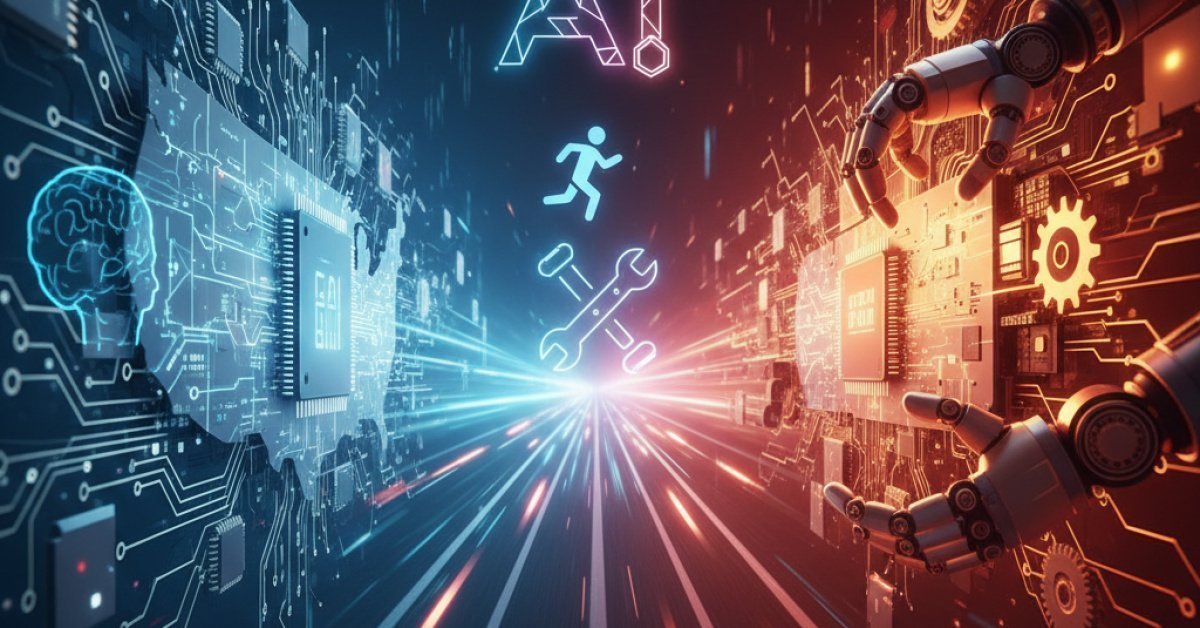
It’s a fundamental divergence. One nation is building the brains; the other is building the bodies. This isn't an accident—it's a direct result of two wildly different market realities.
The Great Subscription Divide: America's Enterprise AI Fortress
Lee is crystal clear on one point: the United States has a massive, perhaps unbreachable, lead in enterprise AI. The reason is surprisingly simple.
"The enterprise adoption will clearly be led by the United States," Lee states. Why? "The Chinese companies have not yet developed a habit of paying for software on a subscription."
That seemingly small cultural difference is a game-changer. The entire business model for companies like Microsoft (with GitHub Copilot) and OpenAI (with ChatGPT Enterprise) relies on businesses paying steady monthly or annual fees. This predictable revenue stream fuels the mind-boggling R&D costs required to build next-generation models.
In China, the subscription model has never really taken off. Lee notes that Chinese tech giants historically found workarounds, like using advertising or e-commerce to monetize consumer software. But for enterprise tools, that model doesn't translate. He suggests someone will need to invent a whole new business model for B2B AI in China, and that "is not going to happen anytime soon."
This gives American enterprise AI companies a powerful, protected market to grow and reinvest, solidifying their lead in cutting-edge research and development.
Consumer AI: Where China's Giants Move at Lightning Speed
But flip the coin, and the story reverses. When it comes to AI that you and I use every day—in social media, e-commerce, and entertainment—Lee sees China pulling ahead decisively.
He argues that Chinese tech behemoths like ByteDance (TikTok), Alibaba, and Tencent will "definitely move a lot faster" than their American counterparts like Meta or Google.
Why the confidence? It boils down to a decade of brutal, hyper-competitive market warfare. "The Chinese giants really work tenaciously, and they have mastered the art of figuring out product-market fit," Lee says. They are obsessed with user engagement and optimization. Now, they're simply plugging powerful AI into their already fine-tuned engagement engines.
We’ve already seen this play out. TikTok’s AI-driven recommendation algorithm is the stuff of legend, creating a user experience so compelling that Western companies are still trying to copy it. China pioneered AI-powered features in live-stream shopping and video editing that are only now making their way to the West. This is their home turf, and they know how to win on it.
The Open-Source Upset: How China Quietly Took the Lead
Perhaps the most startling revelation from Lee concerned the world of open-source AI. For a long time, Meta’s Llama models were considered the gold standard, the best free and open alternative to closed systems like GPT-4.
Not anymore.
"The 10 highest rated open source [models] are from China," Lee declared, a data point that sent a ripple through the audience. Companies like Lee’s own 01.AI, along with Alibaba and others, have released a torrent of powerful models that are now, by many benchmarks, outperforming Llama.
This is a massive shift. Lee is a huge proponent of open-source, drawing an analogy to the operating system wars. "People who work in operating systems loved Linux, and that's why its adoption went through the roof," he explains. He believes open-source AI offers crucial advantages:
- Transparency: You can see the code and understand how it works.
- Customization: You can fine-tune a model for a specific task or language.
- Control: It’s yours. You aren't reliant on a single company.
- Cost: It's free.
He doesn't think open-source will "win" outright, but he predicts a future that looks a lot like the smartphone market. "Just like we have Apple, which is closed, but provides a somewhat better experience than Android... I think we're going to see more apps using open-source models... but I think more money will remain in the closed model."
The Robotics Race: "It's Not Over, But..."
When the topic turned to robotics, Lee’s message became chillingly blunt. He believes China’s structural advantages in manufacturing have created a lead that may be impossible for the U.S. to close.
Asked if the robotics race was already over, he hedged only slightly. "It's not over, but..."
The "but" is everything. While American universities and labs like Boston Dynamics produce incredible research, Lee argues they face a massive hurdle in turning those brilliant prototypes into affordable, mass-market products. Building robots isn’t just about software; it’s about supply chains, hardware integration, and manufacturing at scale.
This is precisely where China has spent the last three decades building an unparalleled global dominance. Companies like Unitree are the proof. They're producing humanoid and quadrupedal robots with capabilities that rival their American counterparts but at a tiny fraction of the cost. In the commercial world, that price-to-performance ratio is almost always the deciding factor.
The problem, again, comes back to investment. U.S. VCs are hesitant to fund capital-intensive hardware companies, while Chinese investors are all in. The U.S. may have the best ideas, but China has the ecosystem to build them cheaply and quickly.
The Real Danger Isn't Skynet—It's Us
For all the talk of competition, what truly worries Kai-Fu Lee isn't some distant threat of a rogue superintelligence. His biggest fear is far more immediate and human.
He's "less afraid of AI becoming self-aware... but more worried about it being used by bad people to do terrible things." More specifically, he fears the "move fast and break things" ethos of the tech industry, supercharged by a global AI race, will lead to disaster.
"I'm very worried about that," he confessed. "In fact, I think some terrible event will happen that will be a wake-up call from this sort of problem."
This isn't just about winning or losing. It's about the very real danger of rushing to deploy powerful, untested technology in a frantic race for dominance. The pressure to beat the competition could cause companies—and countries—to cut corners on safety, creating flawed products with holes that bad actors can exploit.
Lee's perspective suggests we're not just in one race, but many, competing on parallel tracks that may never converge. The U.S. is pulling ahead in the enterprise software marathon, while China is dominating the robotics and consumer application sprints. This bifurcation of the tech world is creating a new, complex global order. The defining question of the next decade won't be who won "the" AI race, but how we navigate a world where leadership is split, and the biggest risk is the race itself.