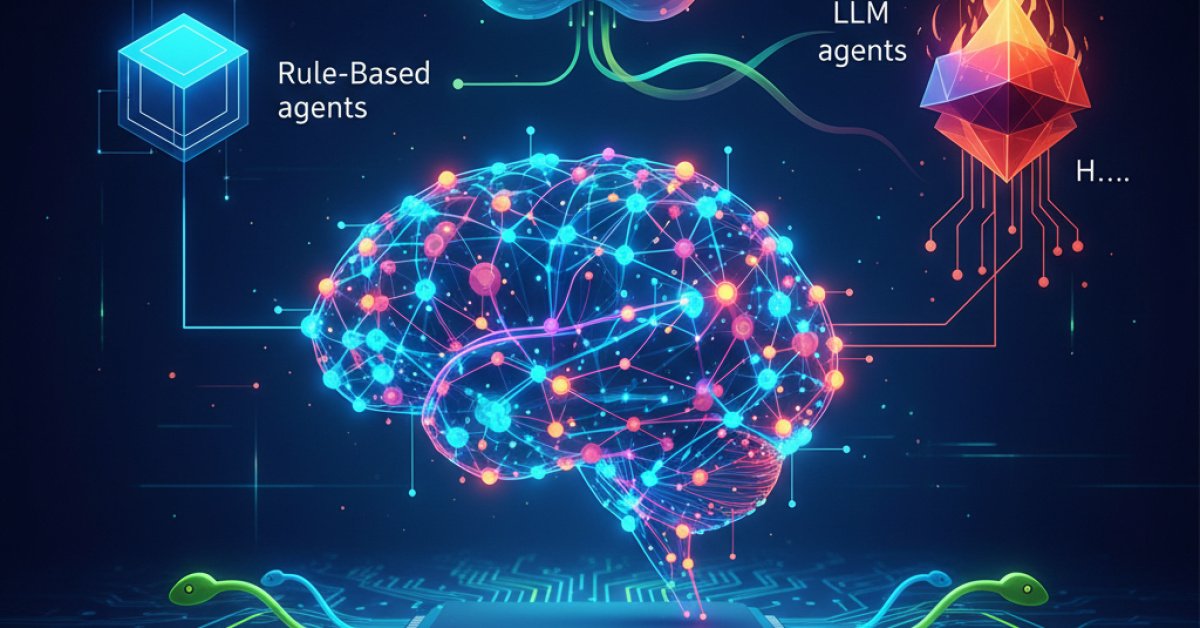
Let's be honest. The hype around AI agents is getting a little out of control. You hear about them automating everything, acting like tiny digital employees, and changing the world. It’s exciting stuff, for sure.
But if you're like me, a part of you is probably thinking, "Okay, but which one do I actually use?"
You've got your old-school, reliable rule-based systems. Then you have the flashy new LLM-powered agents that can seemingly reason and solve complex problems. And somewhere in the middle, you have hybrid models that try to give you the best of both worlds. It feels like choosing between a trusty pickup truck, a sleek self-driving sports car, and a high-tech hybrid sedan. They all get you from A to B, but they’re built for very different jobs.
So, how do we cut through the noise and figure out what really works? We do what any good engineer or tinkerer does: we build a test track and run some races. That’s exactly what I want to walk you through today—how we can build a simple but powerful benchmarking framework in Python to put these different AI agents to the test in a real-world business context.
First, We Need an Obstacle Course
Before we can race our AI agents, we need to build the course. You can't just ask them a random trivia question; you need to test them on tasks they'd actually face in a business environment.
Think of it like creating a standardized exam for AI. We need a suite of challenges that cover different areas and vary in difficulty. For our framework, we designed a set of common enterprise tasks:
- Data Transformation: A classic. "Take this messy CSV of customer data and aggregate the total sales."
- API Integration: Super common. "Call this REST API, parse the JSON response, and pull out the active user count."
- Workflow Automation: This is where it gets interesting. A multi-step process like, "First validate the data, then process it, then generate a report."
- Error Handling: A true test of robustness. "What do you do when you get a chunk of malformed data? Don't crash!"
- Performance Optimization: For the heavy-duty tasks. "Can you make this database query run faster?"
We defined each of these tasks with a clear description, a category (like data_processing or automation), and a complexity score from 1 to 5. Most importantly, we defined what the expected_output should be. Without a correct answer sheet, you can't grade the test! This setup gives us a consistent and fair way to evaluate every agent that comes through.
Meet the Contenders: Our Three AI Agents
With the test track ready, it's time to introduce our competitors. We're pitting three different architectural styles against each other, each with its own philosophy.
1. The Veteran: The Rule-Based Agent
This is your old-school automation script. It doesn't "think" or "reason." It follows a strict set of if-then rules that we program into it. If the task is data_processing, it runs a specific, hard-coded function. If it’s integration, it runs another.
- Strengths: It's incredibly fast, predictable, and reliable. You know exactly what it's going to do every single time. For simple, repetitive tasks, this is often all you need.
- Weaknesses: It's brittle. If anything unexpected happens or the task changes even slightly, it breaks. It has zero adaptability.
2. The Genius: The LLM Agent
This is the new kid on the block, powered by a large language model. Instead of rigid rules, it uses its "reasoning" abilities to figure out how to tackle a task based on the description. We simulate this by giving it the expected answer but introducing a bit of random variation, mimicking how an LLM might get close to the right answer but not always be perfect.
- Strengths: It's incredibly flexible and can handle complex, nuanced tasks that would be a nightmare to code rules for. It can adapt to new information gracefully.
- Weaknesses: It can be slower, less predictable, and sometimes just… wrong. It might hallucinate or misinterpret the request, leading to accuracy issues.
3. The All-Star: The Hybrid Agent
So, what if you could combine the speed and reliability of the rule-based agent with the intelligence of the LLM agent? That's the idea behind the hybrid model.
Our Hybrid Agent is smart. It looks at the task's complexity first. If it's a simple, low-complexity task (say, a 1 or 2 out of 5), it uses a straightforward, rule-based approach to get a perfect, fast result. But if the task is more complex, it switches gears and engages its LLM brain to figure out the solution. It’s a pragmatic approach that plays to the strengths of both technologies.
The Referee: Building the Engine to Run the Tests
Now we have the track and the racers. We just need a referee to start the race, time everyone, and declare a winner. This is our BenchmarkEngine.
This part of the code is the heart of our framework. Its job is to:
- Take an agent and a list of tasks.
- Run each agent through every task multiple times. (Running it more than once helps us get a more stable average and avoid flukes).
- For each run, it carefully measures two key things:
- Execution Time: How long did it take the agent to finish?
- The Output: What answer did the agent give?
Once a task is complete, the engine’s most important job is to calculate an accuracy score. This was a fun little puzzle. How do you score an answer that involves numbers, text, and true/false values?
We came up with a simple system. We compare the agent's output to the expected_output key by key. For numbers, we check if the agent's answer is within a certain tolerance (say, 10%) of the correct value. For booleans (true/false) or strings, it has to be an exact match. The final accuracy is just the average of these individual scores. If it's above a certain threshold (we used 85%), we mark the run as a "success."
This systematic process ensures that every agent is judged by the same criteria, giving us clean, comparable data.
And the Results Are In! Visualizing the Showdown
Running tests is one thing, but staring at a spreadsheet of numbers is no fun. The real magic happens when you visualize the results. It’s where the story and the insights really come to life.
We used a few simple charts to tell the story of our agent showdown:
- Success Rate by Agent: This one is straightforward. Who passed the most tests? We immediately saw that the Hybrid and Rule-Based agents were incredibly reliable, while the LLM agent, despite its intelligence, sometimes failed to meet the success threshold.
- Average Execution Time: Speed matters! The Rule-Based agent was, unsurprisingly, the fastest. The LLM agent was the slowest. The Hybrid agent found a nice middle ground, proving its efficiency.
- Accuracy by Task Complexity: This, for me, was the most revealing chart. We plotted each agent's accuracy against the complexity of the task. For simple tasks, all agents did pretty well. But as the complexity ramped up, you could see the Rule-Based agent's performance (which we simulated as being less capable on complex tasks) start to drop off, while the LLM and Hybrid agents held strong.
Seeing these trends visually makes the trade-offs crystal clear. There isn't one "best" agent—there's the right agent for the right job.
If you need blazing speed and 100% reliability for a simple, unchanging task, the Rule-Based agent is still your champion. If you need to tackle a highly complex, ever-changing problem where adaptability is key, the LLM agent is your go-to.
But for many real-world business scenarios, the Hybrid agent really feels like the winner. It delivers the reliability of rules for the easy stuff and saves its expensive brainpower for the challenges that actually require it. It's efficient, smart, and dependable—a powerful combination.
The point of all this isn't just to declare a winner. It's to show that you can and should measure these things for yourself. Instead of choosing an AI architecture based on a gut feeling or the latest tech trend, you can build a simple framework like this to get real data on what will work best for your specific problems. And that, I think, is how we move from hype to practical, valuable implementation.