We've all been there. You spend hours, maybe even days, diving deep into a topic. You gather sources, synthesize data, and finally produce a killer research report. But that's just the first step, right? Now you have to turn that research into a blog post, a presentation, maybe even a podcast episode. The content treadmill never stops.
What if you could skip all those extra steps? What if you could go from a single research prompt to a comprehensive report, a live webpage, and a ready-to-listen podcast in a matter of minutes? That’s not a hypothetical anymore. The Qwen team at Alibaba just rolled out a massive upgrade to their Qwen Deep Research tool that does exactly that.
This isn't just another AI that summarizes articles. This is a multi-format content production engine, and it’s poised to change how we think about the journey from raw information to published, audience-ready content. Let's break down what this new update is all about and what it means for creators, researchers, and anyone who needs to share information effectively.
What is the New Qwen Deep Research?
At its core, Qwen Deep Research is a feature within the web-based Qwen Chat (Alibaba's answer to ChatGPT). You give it a topic, and it goes to work, generating a detailed report complete with citations. But with this latest update, the "report" is just the starting line.
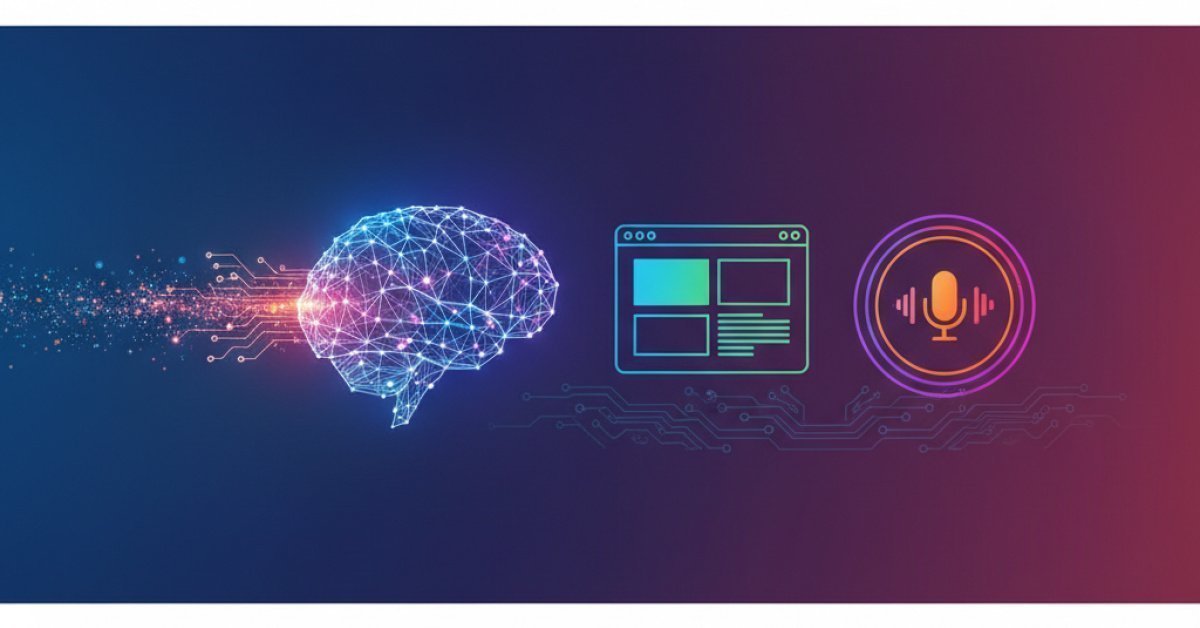
The game-changer is what happens after the research is done. With two new buttons, you can instantly transform that static report into two dynamic formats:
- An Interactive Webpage: A fully-built, professional-looking webpage, complete with AI-generated images and hosted by Qwen. No coding, no web design, no finding a hosting provider. Just click and share.
- A Multi-Speaker Podcast: An audio file featuring two AI hosts discussing the findings of your report. It's not a boring text-to-speech narration; it’s a conversational-style podcast episode.
This is all powered by a suite of Qwen's own models. While the end-to-end experience is a managed, proprietary service, it leverages the open-source power of Qwen3-Coder for the web development, Qwen-Image for the visuals, and Qwen3-TTS for the audio generation. It’s a seamless workflow designed to take the friction out of content creation.
From Prompt to Podcast: A Look at the Workflow
So, how does this actually work in practice? It's surprisingly intuitive. The process feels less like commanding a tool and more like collaborating with a research assistant who also happens to be a web developer and a podcast producer.
The Research and Analysis Phase
It all starts with your prompt in the Qwen Chat interface. Let’s say you want to research the U.S. SaaS market. You don’t just get a wall of text back. Instead, Qwen kicks off a dialogue. It might ask clarifying questions to nail down the scope of your request.
From there, it scours the web, pulling data from industry reports and official sources. This is where it gets really smart. In a demo shared by the Qwen team, the AI identified discrepancies between sources on the market size (one said $206 billion, another $253 billion). It didn't just pick one; it highlighted the conflict, commented on the different scopes of the reports, and provided context for the numbers. It even went a step further and calculated the compound annual growth rate (CAGR) on its own to add another layer of analysis.
The Magic Button: One Click to Multimedia
Once the research is complete and you have your report, you'll see a few new icons. Clicking the "Create" button is where the magic happens. You’re presented with two simple options: "Web Dev" and "Podcast."
- Choose "Web Dev," and Qwen3-Coder gets to work, structuring your report's content into a clean, professional webpage. Simultaneously, Qwen-Image generates relevant inline graphics to make the page visually engaging. Within moments, you have a live, public URL ready to be shared in a presentation, a newsletter, or on social media.
- Choose "Podcast," and Qwen3-TTS spins up an audio file. It generates a script where two AI hosts discuss your research, adding a conversational layer to the information. The result is a downloadable audio file you can listen to on the go.
The beauty is in the simplicity. A single research effort is instantly repurposed into three distinct formats (report, webpage, podcast) without you having to open a single new tab or application.
A Closer Look at the Outputs: Hits and Misses
Of course, the idea is fantastic, but what about the execution? I spent some time generating a few pieces of content myself, one on historical authoritarian regimes and another on UAP sightings, to see how the final products hold up.
The Instant Webpage
The webpages are impressive. They are clean, well-structured, and the AI-generated images are a nice touch, breaking up the text and adding visual appeal. They look far more professional than a simple copy-paste into a CMS. The fact that Qwen hosts the page and provides a public link removes a major technical hurdle for many people. This feature is perfect for students, educators, or analysts who need to present findings quickly and professionally.
The AI-Powered Podcast
The podcast feature is perhaps the more ambitious of the two, and it's where you see both the potential and the current limitations.
The best part is that it's not a simple text-to-speech reading of the report. It’s a genuine attempt at a conversational format, with two hosts bantering and discussing the topic, using the report as their source material. This makes the content far more engaging to listen to. You can choose from a list of 17 names for the host and 7 for the co-host, giving you some control over the podcast's "personality."
However, there are a few quirks. I couldn't find a way to preview the voices before generating the podcast, so it's a bit of a blind pick. And while the narration is dynamic, the voices themselves still have a slightly robotic edge compared to other high-end AI voice tools on the market. Also, it seems the podcast is download-only for now; I couldn't find a way to get a public link for sharing, unlike the webpage.
How Does Qwen Compare to Google's NotebookLM?
Whenever a new AI research tool appears, comparisons are inevitable. The most common one being made is to Google's NotebookLM, which recently came out of beta. Some commentators have even called Qwen's tool a "NotebookLM clone."
While they both operate in the world of "AI-assisted research," they have fundamentally different philosophies.
- Google's NotebookLM is an organizational tool. It's designed to work with your existing documents. You upload your sources—PDFs, Google Docs, web links—and NotebookLM becomes an expert on that specific collection of information, allowing you to ask questions, get summaries, and find connections within your own material.
- Qwen Deep Research is a generative tool. It starts with a blank slate and builds something new from the open web. Its focus is on generating fresh research from scratch and then transforming it into multiple published formats.
So, are they competitors? Yes and no. They cater to different workflows. If you're a student trying to make sense of 20 research papers for a thesis, NotebookLM is your go-to. If you're a content creator who needs to quickly produce a blog post and podcast on a trending topic, Qwen Deep Research is the more direct path.
The Big Picture: A Glimpse into the Future of Content
Qwen's update isn't just about a few cool features; it signals a broader shift in the AI landscape. We're moving away from single-purpose tools and toward integrated, multi-modal platforms that cover the entire content lifecycle, from initial idea to final publication.
By bundling research, analysis, writing, web design, and audio production into one seamless workflow, Qwen is dramatically lowering the barrier to entry for creating high-quality, multimedia content. For solo creators, small marketing teams, and educators, this could be a massive force multiplier.
Of course, it’s not perfect. The AI voices could be more natural, and specialists will likely still want more granular control than a one-click solution provides. But the direction is clear. As of now, Qwen Deep Research is live and available on the Qwen Chat app, with no specific pricing details announced yet.
The old saying was that a good piece of research was the end of a long journey. Tools like this are flipping the script. They're making it clear that a great research report isn't the destination—it's the launchpad.