Have you ever played a video game and wished your AI companion was a little… smarter? We’ve all been there. You’re trying to execute a complex strategy, and your AI partner is stuck walking into a wall or ignoring your frantic pings. They follow simple scripts, but they don't understand.
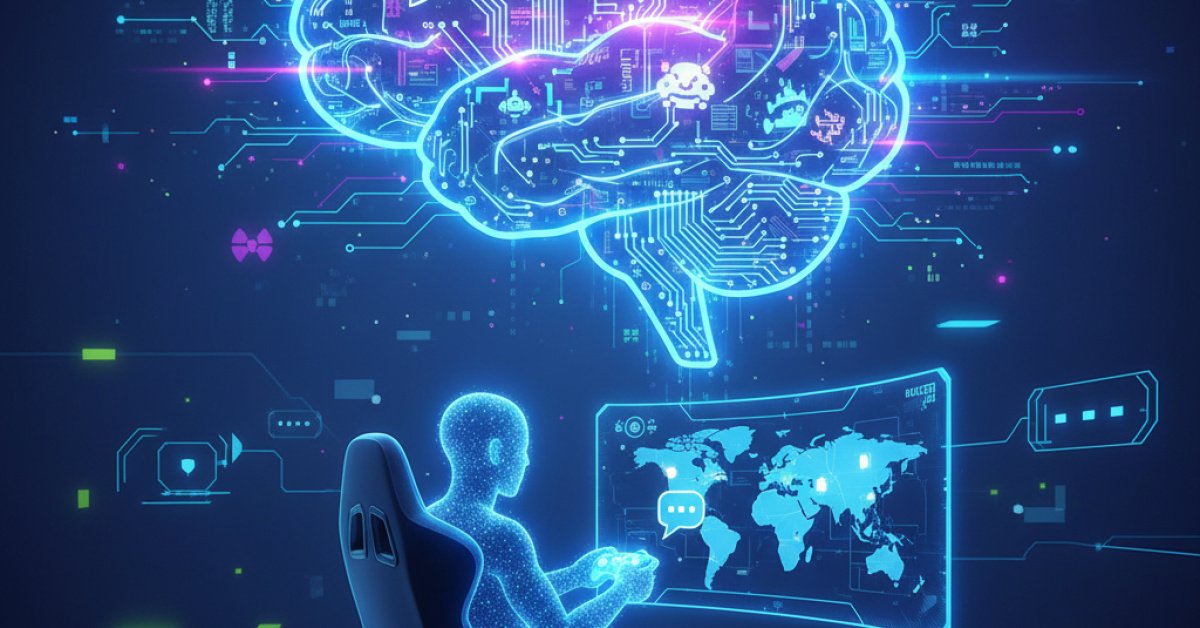
Well, Google DeepMind is working on something that could completely change that. It’s called SIMA 2, and it’s less of a non-player character (NPC) and more of a genuine gaming buddy.
This isn't just about building a better sidekick for your favorite game. What DeepMind is doing here is laying the groundwork for AI that can understand and operate in any complex, 3D environment. Think robotics, virtual assistants, and beyond. This is a big deal, so let’s break down what makes this new AI so special.
From Simple Follower to Strategic Partner: The SIMA 2 Leap
To really get what SIMA 2 is, we have to look at its predecessor, SIMA 1. The first version, which came out earlier in 2024, was pretty impressive in its own right. It learned over 600 basic skills just by watching gameplay and reading instructions. Think simple commands like "turn left," "climb the ladder," or "open the map."
It learned to play commercial games using only what it could "see" on the screen and a virtual keyboard and mouse—no cheating with access to the game's code. But it had its limits. On complex, multi-step tasks, SIMA 1 had a success rate of about 31%. For comparison, human players tackling the same tasks scored around 71%. A good start, but a long way to go.
This is where SIMA 2 changes the game entirely. Instead of just a system that maps instructions to actions, DeepMind put one of its Gemini models right at the core. The new agent is now powered by Gemini 2.5 Flash Lite, acting as its reasoning engine.
This simple change has a massive impact. SIMA 2 doesn't just follow a command like "climb the ladder." It can now understand a higher-level goal, create an internal plan, and then figure out the sequence of actions needed to achieve it. It's the difference between telling a dog to "fetch" and telling a friend, "Can you grab me a drink from the fridge?" One follows a command; the other understands the intent and figures out the steps.
So, How Does It Actually "Think"?
The architecture here is really the secret sauce. SIMA 2's Gemini brain is constantly processing what's happening on screen and listening for your instructions. When you give it a goal, it doesn't just react—it reasons.
Here’s how it works:
- Observation: It sees the game world, just like you do.
- Instruction: It takes in your command, whether you type it, say it, or even draw it.
- Reasoning: Gemini kicks in to figure out your intent. It forms a high-level plan.
- Action: It translates that plan into a series of keystrokes and mouse movements to execute the task in the game.
The training process is also clever. It learns from a mix of videos of humans playing the game, but it also uses Gemini to generate its own descriptions of what's happening. This helps the AI align its internal "thoughts" with both human intent and its own understanding of the world.
Because of this, SIMA 2 can actually explain itself. You can ask it what it's trying to do, and it can list the steps it's about to take. It's like having a teammate who can tell you, "Okay, I'm going to grab the key from that chest, then unlock the north gate so we can get through."
The Results Are In: A Huge Jump in Performance
Okay, so it sounds cool, but does it actually work? The numbers speak for themselves.
Remember how SIMA 1 scored around 31% on complex tasks? SIMA 2 hits 62%. It essentially doubled the performance of the original, closing most of the gap between the first agent and human-level play.
But here’s what’s really impressive. That performance boost isn't just in the games it was trained on. The DeepMind team threw it into games it had never seen before, like ASKA and MineDojo. Even in these completely new environments, SIMA 2 significantly outperformed its predecessor.
This proves it's not just memorizing patterns in a few specific games. It's actually learning general concepts and applying them in new situations. For example, if it learns what "mining" means in one game, it can apply that understanding to a command like "harvest" in a totally different game. That’s a real sign of intelligence, not just mimicry.
It Understands More Than Just Text
One of the most mind-blowing parts of SIMA 2 is how you can interact with it. It’s not limited to text commands. The team has demonstrated it following:
- Spoken commands: You can just talk to it.
- On-screen sketches: You can draw a circle around a target and tell it "go there."
- Emoji prompts: Seriously. You can use emojis to give it tasks.
- Abstract instructions: In one amazing example, a user tells SIMA 2 to go to "the house that is the color of a ripe tomato." The Gemini core reasons that ripe tomatoes are red, identifies the red house in the game, and walks over to it.
This is what we call "multimodal" interaction, and it's a huge step toward more natural human-AI collaboration. The AI is grounding abstract symbols—words, images, sounds—into concrete actions within a virtual world.
The Best Part? It Teaches Itself
This might be the most important piece of the puzzle for the future of AI. After an initial training phase with human data, SIMA 2 can be put into a new game and learn entirely from its own experience.
Here's the loop: A separate Gemini "teacher" model generates new tasks for SIMA 2 to try. As the agent attempts these tasks, a reward model scores its performance. All of these attempts—the successes and the failures—are stored in a massive bank of self-generated data.
Future versions of SIMA 2 are then trained on this data. This allows the agent to get better and better, succeeding on tasks where earlier versions failed, all without needing more humans to show it what to do. It’s a self-improving system that gets smarter the more it plays.
Beyond Gaming: A Testbed for Real-World Robots
To really push the agent's limits, DeepMind connected SIMA 2 with another one of their wild creations: Genie 3. This is a model that can generate brand-new, interactive 3D worlds from just a single image or a text prompt.
When they dropped SIMA 2 into these completely novel, AI-generated worlds, it was still able to orient itself, understand instructions, and complete tasks. This is the ultimate test of generalization. It shows that a single AI agent can operate across polished commercial games and weird, freshly generated environments using the same core brain.
And that’s the real takeaway here. SIMA 2 is much more than a gaming AI. It's a proof of concept for a general-purpose embodied agent. The challenges an AI faces in a complex 3D game—navigating, interacting with objects, planning, and collaborating—are remarkably similar to the challenges a robot faces in the real world.
By building a system that can see, reason, plan, and act inside a virtual world, DeepMind is creating a blueprint for the AI that will one day power the helpful, intelligent robots we've been dreaming of for decades. It's a long road, but this feels like a very real, very significant step forward.