Have you ever heard something in AI that just doesn't seem to make sense? I ran into one of those moments recently when looking at models like Mixtral.
Here’s the puzzle: How can an AI model with a staggering 47 billion parameters run faster and cheaper than a model with, say, 13 billion? On the surface, it sounds impossible. More parameters should mean more work, more computing power, and more time, right?
Well, not always. This is where a really clever architectural trick called Mixture of Experts, or MoE, comes into play. It’s one of the key innovations that’s allowing us to build these massive, incredibly capable models without needing a personal power plant to run them.
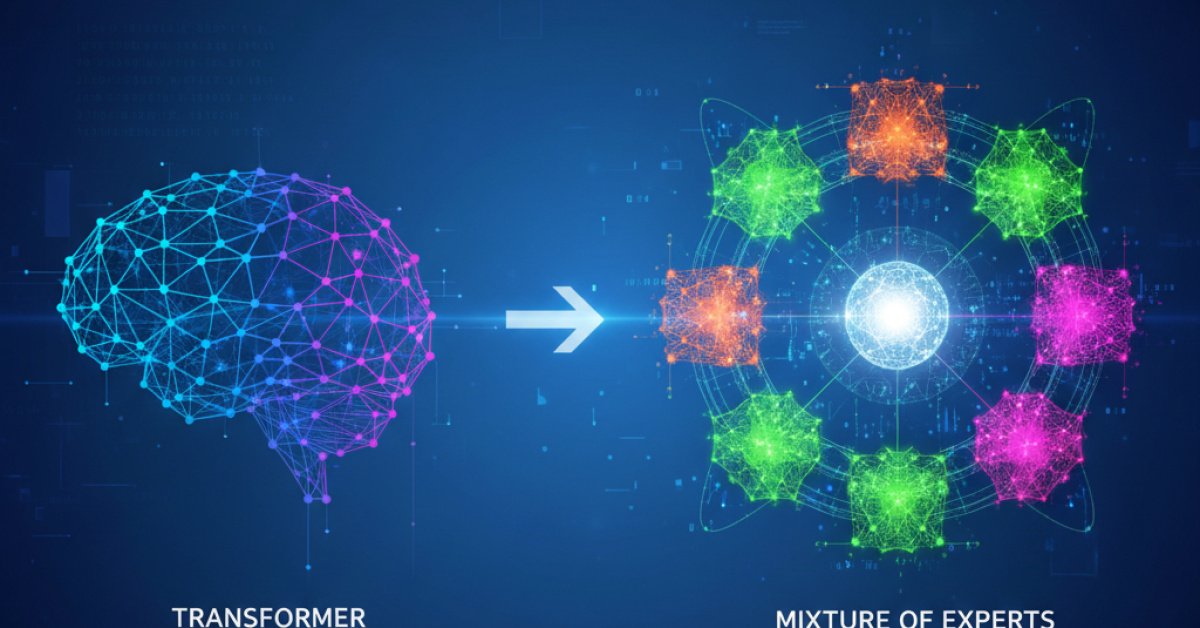
Let's pull back the curtain and see how this actually works. We'll compare the classic Transformer architecture (the backbone of models like GPT) with its newer, more efficient cousin, the MoE.
One Giant Brain vs. a Team of Specialists
At their core, both Transformers and MoE models share the same DNA. They're built from blocks containing those famous self-attention layers that let the model weigh the importance of different words in a sentence. But where they split ways is in the next step: the feed-forward network (FFN).
Think of the FFN as the part of the model that does the heavy "thinking" after paying attention to the context.
The Standard Transformer Approach: In a classic Transformer model, every single piece of data you feed it—every token—gets processed by the exact same, massive feed-forward network. It’s like having one brilliant, all-knowing generalist. This person knows everything about every topic. When you ask a question, they use their entire brain to formulate the answer. It’s effective, but it’s also incredibly intensive. Every neuron fires for every single task. This is what we call dense computation.
The Mixture of Experts (MoE) Approach: An MoE model takes a different route. Instead of one giant FFN, it has a whole team of smaller, specialized FFNs called "experts." And to manage them, it has a "router."
Imagine you walk into a hospital. Instead of being seen by one doctor who knows everything, a triage nurse (the router) quickly assesses your problem and sends you to the right specialist. If you have a heart problem, you see the cardiologist. A skin issue? The dermatologist. You don't waste the neurologist's time with your rash.
That's exactly how MoE works. For each token, the router network looks at it and decides which one or two experts are best suited to handle it. It then sends the token only to those experts.
This is called sparse computation. And it’s the secret to MoE’s magic.
Why "More Parameters" Doesn't Mean "Slower"
This brings us back to our original puzzle. How can more be faster?
A standard Transformer is dense. If it has 70 billion parameters (like Llama 2 70B), it uses all 70 billion parameters to process every single token. The computational cost is huge.
An MoE model might have more total parameters, but it only activates a small fraction of them at any given time.
Let’s look at the perfect real-world example: Mixtral 8x7B.
- The "8x7B" means it has 8 different "experts," each with about 7 billion parameters.
- This gives it a massive library of knowledge, totaling around 47 billion parameters.
- But here’s the kicker: for any given token, its router only picks the top 2 experts. So, it only uses about 13-14 billion parameters for its calculations.
You get the knowledge of a 47-billion-parameter model but the speed and inference cost of a ~13-billion-parameter model. It’s like having an entire encyclopedia on your shelf but only having to read the two most relevant pages.
This makes MoE models incredibly efficient. You can build a model with a vast, diverse understanding of the world without the crippling inference costs you'd get from a dense model of the same size.
The Smart Routing System
So, how does the model know where to send each token? This isn't random; it's a learned process.
In a Transformer, the path is fixed. Every token takes the same highway through the network, layer by layer. There are no detours.
In an MoE model, the router acts like a sophisticated traffic controller. It analyzes the incoming token and assigns it to the experts it thinks will do the best job. A token related to Python code might get sent to the "programming expert," while a token from a Shakespearean sonnet gets sent to the "literature expert."
What's even cooler is that this can change from layer to layer. A token might visit the "syntax expert" in an early layer and then the "semantic meaning expert" in a later one. This allows for an incredible degree of specialization and is a big reason why MoE models are so powerful. They can develop nuanced experts for all sorts of different concepts, patterns, and topics.
So, What's the Catch with MoE?
By now, MoE probably sounds like a free lunch. Massive scale, lower runtime cost... why wouldn't we build every model this way?
Well, as with most things in life and engineering, there are trade-offs. Training MoE models is significantly more complex than training a standard Transformer. You have to worry about a few unique problems.
The Popularity Contest Problem
One major challenge is load imbalance. The router might decide that one or two experts are just really good and start sending almost all the tokens to them. Meanwhile, other experts are left sitting around, under-trained and useless. It's like everyone deciding the cardiologist is the best doctor for every ailment, leaving the other specialists with no patients and no way to improve.
The "Expert Collapse" Trap
A related issue is expert collapse. This is an extreme version where the router essentially gives up and sends everything to a single expert, defeating the entire purpose of the architecture.
To get around these issues, engineers use a few clever tricks. They might inject a bit of "noise" into the routing decision to encourage variety, or they set capacity limits so no single expert can get overwhelmed with too many tokens. These solutions work, but they add a layer of complexity to the training process that you just don't have with a simple, dense model.
Ultimately, the choice between a dense Transformer and an MoE model is a design decision. MoE gives you this incredible ability to scale up the model's "knowledge" without a proportional increase in the cost to run it. It’s a work-smarter-not-harder approach that’s pushing the boundaries of what's possible with large-scale AI. And now, the next time you see a model with a mind-boggling parameter count running surprisingly fast, you'll know exactly how it's done.