Have you ever sat there, watching the cursor blink as an AI slowly types out its response, one word at a time? It’s a familiar feeling. We want our AI assistants to be fast, but we also need them to be smart and coherent. For a long time, it felt like we had to choose: speed or quality.
The traditional way LLMs work, called "autoregressive," is like a careful writer. It writes one word, rereads the sentence, and then painstakingly chooses the very next word. It’s methodical, and it produces high-quality, logical text. But man, is it slow.
On the other side, you have different approaches like "diffusion models." You can think of these as the impatient, creative types. They don't write word-by-word; they kind of sketch out a whole paragraph at once and then refine it. It's much faster in theory, but the final result can sometimes feel a bit… off. The sentences might not connect perfectly, or the facts can get jumbled.
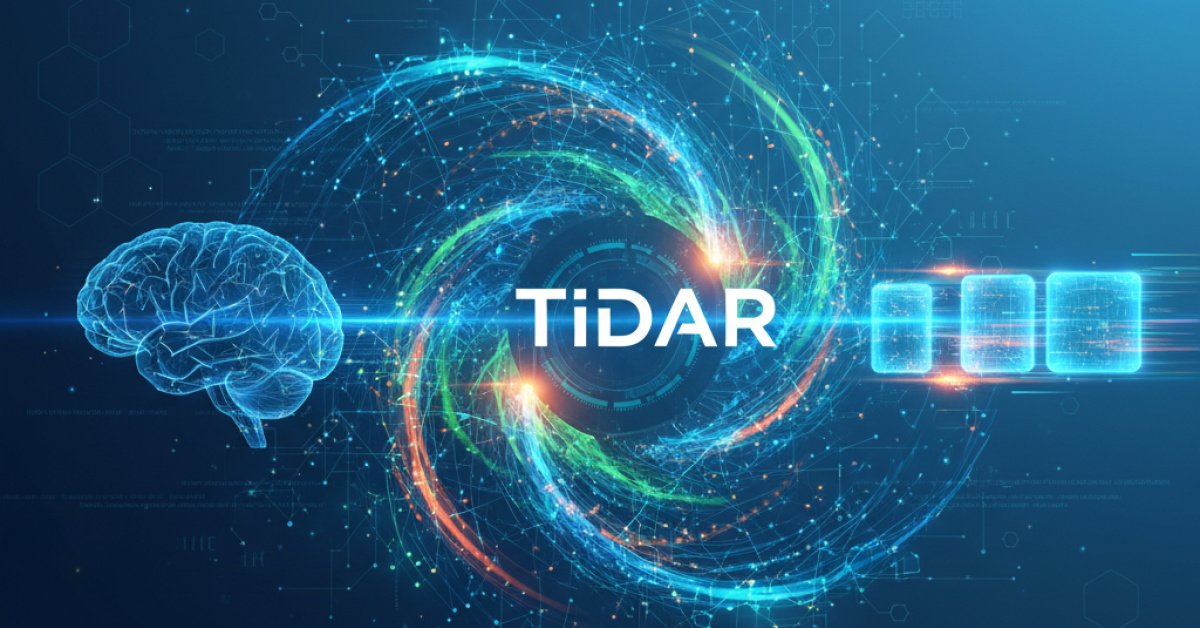
So, the big question in the AI world has been: can we get the speed of the creative sketch artist with the precision of the methodical writer? Researchers at NVIDIA think they’ve cracked it, and their solution is called TiDAR.
The "Free Lunch" Hiding in Your GPU
To understand what makes TiDAR so clever, you first need to know a little secret about how GPUs work with these models. When an LLM generates a single token (a word or part of a word), your powerful GPU has to load a ton of data—the model's weights and its "memory" of the conversation, known as the KV cache.
Here's the thing: loading all that data is the slow part. The actual math to calculate the next token is super fast. It’s like driving a massive delivery truck across town just to drop off a single, tiny package. The drive takes forever, but dropping off the package takes a second.
NVIDIA's team realized that whether the truck carries one package or ten, the travel time is almost the same. In GPU terms, this means processing a few extra tokens at the same time barely adds any latency. They call these "free token slots."
Diffusion models try to use these slots by generating a bunch of tokens at once. But, as we talked about, they do this by guessing each token independently, which can hurt the overall quality. This is where TiDAR comes in with a genuinely brilliant hybrid approach.
Meet TiDAR: The Best of Both Worlds
At its core, TiDAR is a single language model that has learned to act like two different models at the same time. It’s part speedy drafter and part meticulous editor, and it does both jobs in a single step.
Imagine the model is writing a sentence. Here’s how it works:
- The Prefix: This is the part of the sentence that’s already been written and confirmed. It’s solid.
- The Draft: TiDAR uses its diffusion-style brain to quickly "draft" a chunk of new tokens—say, the next 8 or 16 words—all at once. It fills up those "free token slots" on the GPU.
- The Verification: At the exact same time, it uses its autoregressive-style brain to look at the prefix and the newly drafted words and ask, "Does this make sense?" It checks the drafted words one by one, just like a traditional model would.
This whole process—drafting and verifying—happens in a single forward pass of the model. It's a self-speculative process. The model makes a bunch of educated guesses (the draft) and then immediately checks its own work (the verification).
Words that pass the check are officially added to the prefix. Words that don't? They're simply tossed out. No harm, no foul. The model then drafts a new batch and repeats the process.
A Single Brain, Two Personalities
You might be wondering, "How can one model do two different things at once?" This is where the engineering is really elegant.
During training, the researchers basically taught the model to be bilingual. They fed it sequences of text and trained it on two tasks simultaneously:
- Causal Mode (The Editor): For one part of the input, it learned standard next-token prediction, just like any autoregressive model (e.g., GPT).
- Diffusion Mode (The Drafter): For another part, they completely masked out the text and taught the model to reconstruct it from scratch, forcing it to learn how to generate entire blocks of text in parallel.
By using a clever "attention mask," the model knows which personality to use for which part of the text. It applies its careful, one-word-at-a-time logic to the existing prefix and its fast, block-based logic to the new draft section. It’s all handled by the same set of weights, the same backbone. No need for a separate, smaller model to generate drafts, which is what some other speed-up techniques do.
So, How Fast Is It, Really?
Alright, let's get to the results. This all sounds great in theory, but does it actually work in practice?
Oh yeah. It works.
The NVIDIA team took popular open-source models (from the Qwen family) and continued training them to become TiDAR models. Here’s what they found when running them on a single H100 GPU:
- The 1.5 billion parameter TiDAR model was 4.71 times faster than its original autoregressive version.
- The 8 billion parameter TiDAR model was a whopping 5.91 times faster than its counterpart.
And here’s the kicker: it achieved this speed-up with almost no loss in quality. On tough benchmarks for coding (HumanEval), math (GSM8K), and general knowledge (MMLU), the TiDAR models performed just as well as the slower, original models.
It effectively turns those "free token slots" into real, high-quality tokens. Instead of generating just one token per step, the 8B model was successfully generating an average of 8.25 tokens per forward pass. That’s a massive leap in efficiency.
Why This Is a Big Deal
TiDAR isn't just another incremental improvement. It feels like a genuine step forward in bridging the gap between two different philosophies of AI generation. It elegantly combines the raw parallel power of diffusion with the logical coherence of autoregression.
By building this into a single, unified model, they’ve avoided the complexities and overhead of other methods that bolt a "drafting" model onto a "verifying" model. It’s cleaner, more efficient, and, based on the results, incredibly effective.
For you and me, this means the future of AI could be a lot snappier. Imagine chatbots that respond instantly, coding assistants that complete entire functions in the blink of an eye, and creative tools that generate paragraphs of text without that frustrating, word-by-word delay.
TiDAR shows us that we might not have to choose between speed and quality for much longer. We can have our cake and eat it too, all thanks to a clever way of making sure that delivery truck is always full.