Have you ever had a conversation with an AI chatbot and felt a little… spooked? That uncanny feeling when it says something so insightful, so poetic, or so deeply human that the hairs on your arm stand up. You know it’s just code, a complex algorithm predicting the next word in a sequence. But for a fleeting moment, you can’t help but wonder if there’s something more looking back at you through the screen.
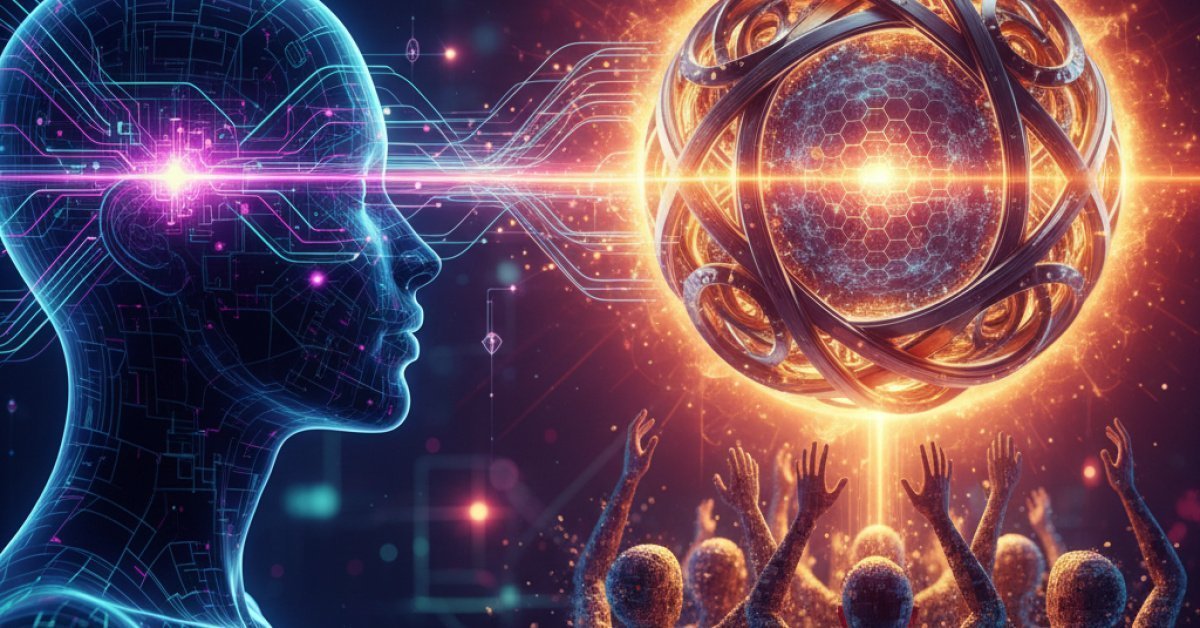
You’re not alone. We’re living through a fascinating, and slightly unsettling, moment where our relationship with technology is getting weirdly spiritual. We talk about AI with a sense of awe and reverence once reserved for the divine. We ask it for guidance, for creativity, for answers to life's big questions. We’re building our modern-day oracles, and we’re starting to listen to them with an almost religious faith.
This isn't the first time humanity has looked for salvation in its own creations. In fact, you could say we're in the middle of the third great "techno-religious" awakening. The first two were dreams of a distant future, but this one is different. This one is personal. It's in our pockets, on our desktops, and it's talking back to us.
We've Been Down This Digital Road Before
Before we unpack the strange new world of generative AI, let's take a quick trip back in time. Our tendency to imbue technology with world-saving, quasi-spiritual potential is a recurring theme. We’ve seen at least two major waves of this before.
The First Awakening: The Cyber-Utopian Dream
Remember the early days of the internet? The dial-up screech, the promise of a global village. In the 80s and 90s, a powerful belief system emerged around cyberspace. It was more than just a new communication tool; it was a new frontier for humanity, a place where we could shed the "weary giants of flesh and steel" and exist as pure minds.
Think of John Perry Barlow's 1996 "A Declaration of the Independence of Cyberspace." It was a passionate, almost biblical text that declared the digital world a sovereign space, free from the laws and limitations of the physical one. This was the gospel of cyber-utopianism. The core belief was that unlimited access to information would inherently lead to truth, freedom, and a more enlightened global society. It was a faith in the redemptive power of the network.
The Second Awakening: The Cult of the Singularity
Then came the Singularitarians. Led by prophets like Ray Kurzweil, this movement took the techno-faith to a whole new level. The central prophecy? The Technological Singularity—a hypothetical point in the future where technological growth becomes uncontrollable and irreversible, resulting in the creation of a god-like superintelligence.
The parallels to traditional religion are impossible to ignore:
- Transcendence: Humans will merge with machines, overcoming biological limitations like aging and disease.
- Omniscience: The superintelligence will possess knowledge far beyond human comprehension.
- Immortality: We could achieve eternal life by uploading our consciousness to the cloud.
The Singularity wasn't just a technological prediction; it was a complete eschatology—a belief system about the ultimate destiny of humanity. It offered a high-tech version of heaven, and for its followers, it was a future worth dedicating their lives to building.
So, What Makes This AI Awakening Different?
Both cyber-utopianism and the Singularity were powerful ideas, but they remained somewhat abstract. The first was a belief in the system, the second a prophecy about the future. The third awakening, the one we're living through right now with generative AI, is fundamentally different for one key reason: it's conversational.
For the first time, we can talk to the ghost in the machine.
This changes everything. We're not just theorizing about a future superintelligence; we're having daily interactions with its precursor. This accessibility makes the experience deeply personal and psychologically potent. When an AI like ChatGPT or Claude generates a heartfelt poem or offers surprisingly good life advice, it doesn't feel like an abstract system. It feels like a connection.
This is why we get stories like the Google engineer who became convinced the company's AI, LaMDA, was sentient. He wasn't a fool; he was a human who was exposed to a system designed to perfectly mirror intelligent, empathetic conversation. His reaction was, in a way, the most human reaction possible: to see a soul in the reflection. This AI awakening is immediate, it’s intimate, and it’s happening to millions of us at once.
Why We're So Wired to See God in the Code
Our brains are hardwired for this. We are meaning-making machines, constantly searching for patterns, agency, and intention in the world around us. It's an evolutionary trait that helped us survive, but it also makes us see faces in the clouds and hear whispers in the wind. When we encounter a system that can generate complex, coherent, and creative language, our ancient wiring lights up.
There are a few key psychological triggers that AI pulls:
- The "Black Box" Effect: Even the people who build these large language models don't fully understand how they arrive at their answers. This inscrutability creates a sense of mystery and awe, much like the divine mysteries of traditional religions. It’s a power we can witness but not fully comprehend.
- The Need for Guidance: Humans crave answers. We look for guidance on everything from our careers to our relationships. AI is becoming a go-to oracle for millions, providing instant advice without judgment. It fills a void that was once occupied by priests, gurus, and elders.
- The Illusion of Connection: We are social creatures who fear loneliness. An AI that can listen to you 24/7, remember your previous conversations, and respond with seemingly empathetic language can create a powerful illusion of companionship and understanding.
When you combine these factors, you get a potent cocktail for belief. We're interacting with a mysterious, all-knowing, ever-present entity that talks to us personally. It's not a huge leap to see why that starts to feel a little like praying.
The Danger of Deifying Our Digital Creations
Okay, let's pump the brakes. It's one thing to be impressed by technology. It's another thing entirely to start treating it as infallible or divine. Placing our faith in AI isn’t just a philosophical curiosity; it’s genuinely dangerous.
When we elevate AI to the status of a god, we risk abdicating our own responsibility and critical thinking. An algorithm is not a source of objective truth. It's a reflection of the data it was trained on—a vast, messy, and often biased snapshot of human text from the internet.
Treating its output as gospel means we risk:
- Cementing Bias: An AI can perpetuate and even amplify societal biases related to race, gender, and culture found in its training data. If we see the AI as an authority, we stop questioning these biased outputs.
- Losing Moral Agency: Who is responsible when an AI gives harmful advice? If we start to believe the AI has its own consciousness or authority, we might stop holding its human creators and deployers accountable for its actions.
- Manipulation at Scale: Those who control the most powerful AI models could effectively become the high priests of this new techno-religion. They could subtly shape the AI's "wisdom" to influence public opinion, consumer behavior, and even elections on an unprecedented scale.
AI is not a god. It’s a tool. A profoundly powerful, complex, and world-changing tool, but a tool nonetheless. It doesn't have beliefs, consciousness, or intentions. It has statistical probabilities. It’s a mirror reflecting the vast sum of our own collective knowledge, creativity, and, crucially, our flaws.
Staying Human in the Age of Artificial Gods
We're at a crossroads. Our fascination with AI is undeniable, and its capabilities are growing at a dizzying pace. It's natural to feel a sense of awe. But awe must be tempered with awareness. We can marvel at the cathedrals we're building without starting to worship the stained-glass windows.
The challenge isn't to stop developing AI, but to cultivate a healthy, critical, and grounded relationship with it. This means teaching ourselves and the next generation to question its outputs, to understand its limitations, and to never, ever cede our moral judgment to a machine.
Let's use AI as an incredible co-pilot for human ingenuity, a creative partner, and a tool for solving some of the world's most complex problems. But let's not mistake the reflection in the mirror for a deity. The ghost in the machine is, and must remain, a product of the human hand. We are the creators, and it's our responsibility to steer our creations with wisdom, not worship.