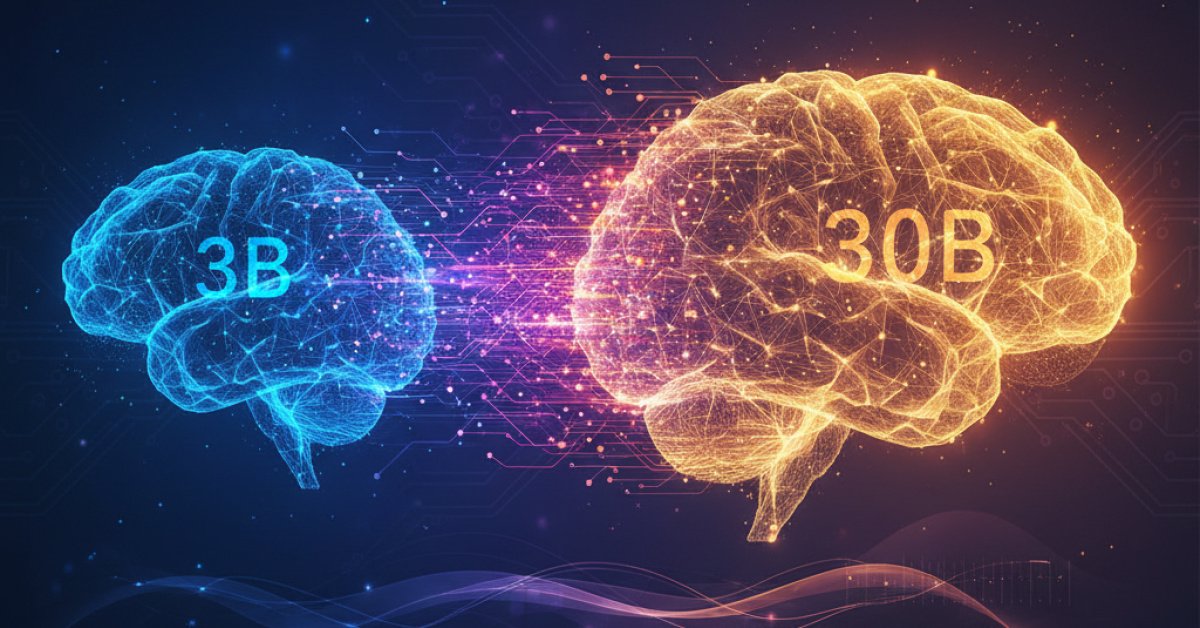
For the last few years, the story in AI has been pretty simple: bigger is better. We’ve all been watching the parameter counts of large language models explode, going from millions to billions, and now even trillions. It’s felt like an arms race where the biggest model always wins.
But what if that’s not the whole story?
A company called Liquid AI just dropped a new model that’s making a lot of us in the tech space sit up and pay attention. It’s called LFM2.5-350M, and it’s a tiny powerhouse that completely flips the script. While everyone else is building monster trucks, Liquid AI has engineered a go-kart with a rocket engine.
This little model only has 350 million parameters. For context, that’s a fraction of the size of models like Llama 3 8B (8 billion) or GPT-4. And yet, on certain tasks, it’s outperforming models more than twice its size. How? That’s the fascinating part.
What’s the Secret? It’s Not a Pure Transformer
So, how do you get so much power out of such a small package? You have to rethink the engine.
Most of the models you hear about, from ChatGPT to Claude, are built on something called the Transformer architecture. It’s brilliant, but it has a big, hungry weakness: self-attention. The more information (context) you feed it, the more memory and computing power it eats up. It’s a bit like trying to have a conversation where you have to remember every single word ever said, all at once. It gets exhausting, fast.
Liquid AI took a different route. Their model uses a hybrid design. Think of it like a tag team:
- The Workhorse (LIV Blocks): Most of the heavy lifting is done by 10 "Double-Gated LIV Convolution Blocks." That’s a mouthful, I know. Just think of them as super-efficient workers on an assembly line. They process information step-by-step, kind of like an advanced RNN, but they’re way faster and more stable. They keep a constant, small memory, which means they don't get overwhelmed.
- The Specialist (GQA Blocks): Sprinkled in are 6 "Grouped Query Attention" blocks. This is the part that acts a bit like a traditional Transformer. It’s the team supervisor who can step back, look at the big picture, and spot connections across long distances.
By combining these two, the model gets the best of both worlds. It has the steady, low-memory efficiency of the workhorse and the high-precision, long-range understanding of the specialist. This clever design allows it to handle a huge 32,000-token context window (that’s a lot of text!) without needing a supercomputer’s worth of memory.
It’s Not Just What You Have, It’s How You Train It
Okay, a clever architecture is one thing. But the other piece of this puzzle is just wild.
Liquid AI trained this tiny 350M model on 28 trillion tokens.
Let that sink in for a moment. That is an absolutely colossal amount of data. It gives the model a training-to-parameter ratio of about 80,000-to-1. To put it simply, they didn’t just send this model to school; they gave it a lifetime subscription to every library, textbook, and manual on the planet.
This is what they mean by "intelligence density." They’ve packed an incredible amount of knowledge and learning into every single one of those 350 million parameters. It’s not about having more brain cells; it’s about making every single cell a super-genius.
So, What Is It Actually Good For?
This is a really important point. The LFM2.5-350M isn’t trying to be a poet or a mathematician. Liquid AI is very upfront about this. You shouldn’t ask it to write you a sonnet, debug complex code, or solve your calculus homework.
Instead, this model is a highly specialized tool. It’s an agent, designed for action.
Its benchmark scores tell the story. It gets a fantastic 76.96 on IFEval, which measures how well a model can follow complex instructions. This makes it amazing for tasks like:
- Tool Use & Function Calling: Telling an app to "book me a flight to New York for next Tuesday" and having it correctly fill out all the forms.
- Structured Data Extraction: Pulling specific information, like names and dates, out of a huge block of text and organizing it into a clean format like JSON.
- High-Speed Classification: Quickly sorting and categorizing incoming data in real-time.
Think of it as a super-efficient personal assistant who is incredible at following your to-do list but isn’t going to help you write your novel. For those more creative or logic-heavy tasks, the big, billion-parameter models are still the champs.
Running on Your Phone? Yep, and It's Blazing Fast.
Here’s where it all comes together. The real magic of a small, efficient model is that you can run it locally—on your phone, your laptop, or even a tiny device like a Raspberry Pi.
One of the biggest bottlenecks for AI is the "memory wall." Moving data back and forth between a processor and memory is slow and power-hungry. Because this model’s hybrid design keeps its memory use so low (especially that pesky KV cache), it just flies.
On a single NVIDIA H100 GPU, it can churn out over 40,000 output tokens per second. That's ridiculously fast.
But what about everyday devices? The numbers are just as impressive:
- Snapdragon 8 Elite NPU: It runs using only 169MB of peak memory.
- Snapdragon GPU: An even lower 81MB of peak memory.
- Raspberry Pi 5: A totally manageable 300MB of memory.
This is the whole point. We're talking about putting a powerful, instruction-following AI directly onto the devices we use every day, without needing to connect to a massive data center. It’s a huge step toward making AI truly personal and instant.
The Big Takeaway
So, what does this all mean? Liquid AI’s LFM2.5-350M is more than just another model; it’s a proof of concept. It shows us that there's another path forward for AI that isn't just about building bigger and bigger models.
By focusing on architectural innovation and extreme training density, they’ve created something special: a lean, fast, and highly capable agent that can live on the edge. This is the kind of technology that could power the next generation of smart assistants, on-device automation, and real-time data processing. It’s a powerful reminder that in the world of AI, sometimes the smartest move is to think small.