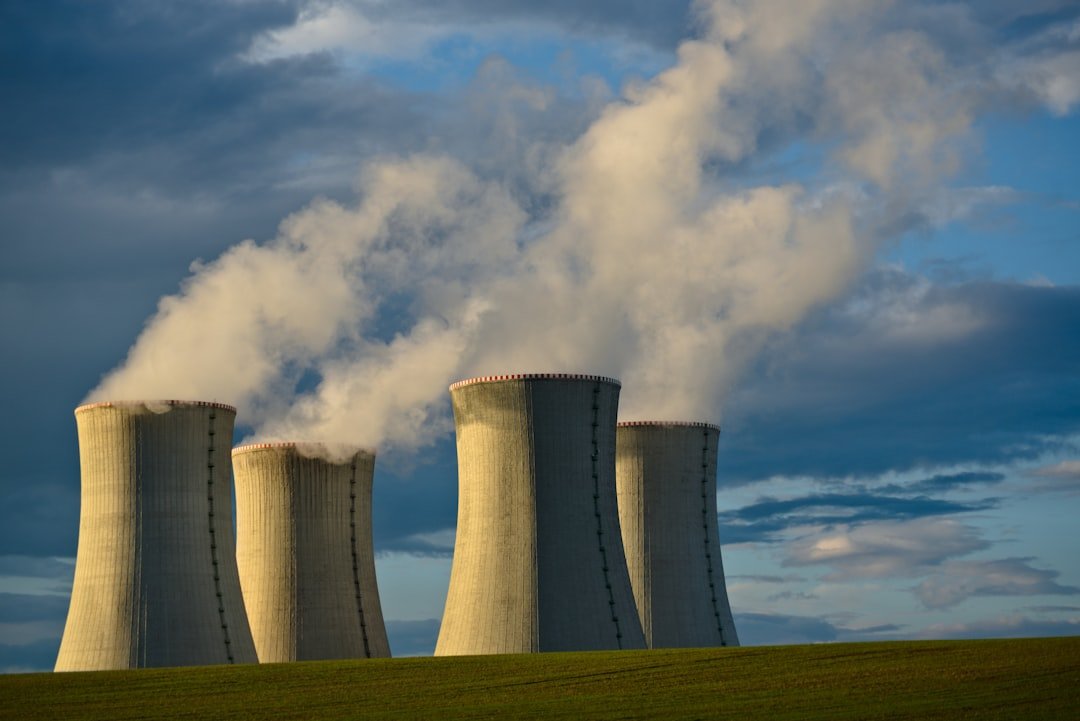
Let’s be honest, summer heat feels different these days. It’s not just hot; it’s heavy. We’ve all seen the headlines about heat waves straining power grids to their breaking point. The cycle is pretty vicious: it gets hotter, we crank up the air conditioning, which demands more power, which puts even more stress on the grid.
But what if I told you there’s a way to cool things down that doesn’t use a single watt of electricity? And what if I told you the basic idea has been around for thousands of years?
It’s called radiative cooling, and it’s one of the most fascinating and practical bits of tech I’ve come across lately. We’re talking about special paints, coatings, and even fabrics that can literally beam heat away from a surface. It sounds like science fiction, but it’s very real, and it’s happening right now.
So, What Exactly Is This "Radiative Cooling" Thing?
You've actually seen this in action, even if you didn't know what it was called.
Ever walked out to your car on a clear morning and found it covered in dew, even when the air doesn't feel that cold? That's radiative cooling! Qiaoqiang Gan, a professor at King Abdullah University of Science and Technology, explains it perfectly. During the day, your car absorbs heat from the sun. At night, it radiates that heat back out into the clear sky. This process can make the car's metal roof slightly cooler than the air around it, causing moisture to condense. That's your dew.
This isn't a new discovery. For millennia, people have been cleverly using this natural phenomenon. In the deserts of Iran and North Africa, people would leave shallow pools of water exposed to the clear night sky. By morning, the water would have radiated so much heat away that it would freeze into ice—in the middle of the desert! On a simpler level, think of the white-washed buildings in Greece. That’s a basic form of a “cool roof,” using a reflective color to scatter sunlight and keep the inside temperature down.
As Aaswath Raman, a materials scientist at UCLA, puts it, "People have taken advantage of this effect, either knowingly or unknowingly, for a very long time."
Bringing an Old Idea into the 21st Century
Harnessing this effect at night is one thing. But the real challenge, the holy grail, has always been: can we make it work during the day, when the sun is actively trying to cook everything?
For a long time, the answer was no. A surface in direct sunlight just couldn't get cooler than the air around it.
That all changed back in 2014. Raman and his colleagues had a breakthrough. They engineered special photonic films that could do the impossible: achieve radiative cooling in broad daylight.
Here’s the cool part. Think of our atmosphere as a giant, cozy blanket that traps heat. But this blanket has a tiny, specific hole in it—an "atmospheric window" for infrared wavelengths between 8 and 13 micrometers. Heat at this exact frequency can pass straight through the atmosphere and escape into the cold vacuum of space. Raman's films were designed to absorb heat from a building and then radiate it out precisely in that sweet spot.
The results were stunning. They could cool the inside of a building to 9°F below the outside temperature, under the full sun, with zero energy input. It was the proof of concept everyone was waiting for.
From Sci-Fi Films to Super-Reflective Paints
That high-tech film was amazing, but a little too complex and expensive for widespread use. So, the industry has since shifted its focus to something simpler, more durable, and much more scalable.
Instead of trying to hit that narrow atmospheric window, the new goal is more straightforward: just reflect as much sunlight as humanly possible, across all wavelengths. We're talking about advanced ceramic coatings, polymers with nanostructures, and other materials that are basically the most reflective white you’ve ever seen.
And this has kicked off a full-on commercial race. Startups like SkyCool (which Raman co-founded), Planck Energies, Spacecool, and i2Cool are all competing to create the best passive cooling coatings on the market. Their target is to make materials that reflect at least 94% of sunlight, and in humid tropical climates, a whopping 97% or more.
This isn't just lab talk, either. Pilot projects are already showing incredible results. By applying these coatings to residential buildings, they've been able to slash the energy needed for air conditioning by 15% to 20%. That’s a huge deal.
It's Not Just for Roofs Anymore
The potential for this tech goes way beyond just painting rooftops and roads. Researchers are now looking at how to apply these principles to us.
Imagine a T-shirt that actively keeps you cool while you're out in the sun. That’s what Gan calls "personal thermal management." They're developing reflective textiles that can be woven into sportswear, work uniforms, and everyday garments. For people who have to work outside or are especially vulnerable to heat, this could be a life-saver.
It’s a fundamental shift from cooling our spaces to cooling ourselves, directly and passively.
Okay, What's the Catch?
Now, before we get too carried away and think we can just paint our way out of climate change, we need to have a real talk about the limitations. Because, like any technology, this isn't a magic bullet.
For one, it’s weather-dependent. Just like solar panels need sun, radiative cooling needs a clear path to the sky. Heavy cloud cover basically closes that "window" to space, trapping the heat.
Dust, dirt, and air pollution are also a problem. They can settle on these super-bright surfaces and dim their reflectivity over time. A coating that’s 97% reflective when it’s new might be a lot less effective after a few years of real-world grime.
But the biggest challenge, and the one that researchers are most focused on, is the materials themselves. Right now, some of the cheapest and most durable materials for radiative cooling rely on fluoropolymers—you might know them by the brand name Teflon. These are part of a family of "forever chemicals" that don't break down in the environment, posing a serious long-term risk.
"They are the best class of products that tend to survive outdoors," Raman admits. The big question for the industry is, "Can you do it without materials like those fluoropolymers and still maintain the durability and hit this low cost point?"
So, is a shiny roof the answer to all our problems? Of course not. As Gan says, "We cannot be overoptimistic." We're still going to need more efficient air conditioning and a whole host of other solutions.
But it's an incredibly smart, powerful, and frankly, elegant tool to add to our toolbox. It takes an ancient, natural process and gives it a 21st-century boost. It's a reminder that sometimes, the most effective solutions are the ones that work with nature, not against it. And in a world that’s getting hotter by the day, that’s a pretty cool thought.