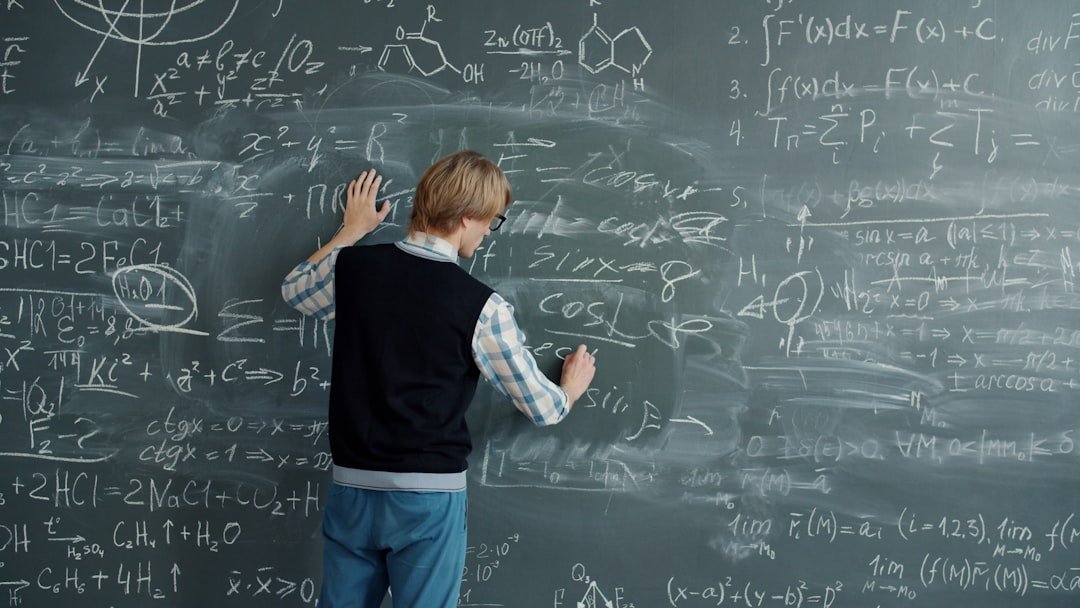
Remember staring at a math problem in high school, feeling like your brain was hitting a brick wall? The symbols swam, the logic felt just out of reach, and you wondered how anyone could possibly invent this stuff. For many of us, that feeling never really goes away, especially when we hear about things like Fermat's Last Theorem or the Riemann Hypothesis—problems that have stumped the greatest human minds for centuries.
Now, imagine an AI that doesn't just calculate, but reasons. An AI that can navigate the abstract, elegant, and often frustrating world of pure mathematics. That's the promise whispered around OpenAI's next-generation model, the highly anticipated GPT-5. The core claim is a monumental one: a breakthrough in reasoning for math and logic, giving the AI the ability to "think" more deeply about a problem.
This isn't just about getting your homework done faster. If an AI can genuinely tackle advanced mathematical proofs, it's a fundamental shift in what we thought machines were capable of. It’s the difference between a tool that can follow a recipe and a chef that can create a new one from scratch. So, let's unpack what this really means. Is GPT-5 about to become the next great mathematician, or are we getting ahead of ourselves?
Why Proving Math is AI's Everest
Before we get hyped about GPT-5, we need to understand why this is such a hard problem in the first place. Large Language Models (LLMs) like ChatGPT-4 are incredible mimics. They've been trained on nearly the entire internet, so they can recognize patterns and regurgitate information with stunning accuracy. They can write a sonnet, debug code, or explain quantum physics at a high level.
But proving a novel mathematical theorem isn't about regurgitation. It's about pure, abstract logic and, dare I say, creativity.
Here’s what makes it so tough for an AI:
- Absolute Precision is Required: In an essay, you can be 99% right and get an A. In a math proof, a single flawed step makes the entire thing invalid. There's no room for "close enough."
- It’s Not Just About Calculation: A calculator can do arithmetic. A computer algebra system can solve complex equations. But a proof requires building a logical bridge from a set of assumptions (axioms) to a conclusion, where every single step is justified and sound.
- The "Aha!" Moment: Mathematicians often talk about intuition—a gut feeling that a certain path is the right one to explore. This creative leap is incredibly difficult to program. Current AIs often get stuck in logical dead ends or produce "proofs" that look plausible but contain subtle, fatal flaws.
GPT-4 is pretty good at solving problems that have well-established methods. It can nail a calculus exam or walk you through a textbook proof. But ask it to prove something genuinely new, and it often stumbles. It's like a brilliant student who has memorized every formula but hasn't yet learned how to think like a true mathematician.
So, What's Supposedly Different About GPT-5?
The buzz around GPT-5 isn't just about it being "smarter." It's about a potential change in its core architecture and capabilities, specifically targeting this reasoning deficit. The idea is that it can move beyond simple pattern matching to something that more closely resembles structured thought.
Deeper Reasoning: Beyond Chain-of-Thought
You might have heard of "Chain-of-Thought" (CoT) prompting. That's when you ask an AI to "think step-by-step." It's a clever trick that forces the model to lay out its reasoning process, which often leads to better answers. But it's still a prompt-based workaround.
The speculation is that GPT-5 will have this kind of deliberate, step-by-step reasoning baked into its core. Instead of spitting out an answer in one go, it might internally allocate more "thinking time" and computational power to complex prompts. Think of it as the AI equivalent of taking a deep breath and grabbing a whiteboard before tackling a tough problem.
This "System 2" thinking, as it's often called (borrowing from psychologist Daniel Kahneman's model of the brain), could allow the AI to:
- Evaluate multiple potential steps in a proof.
- Check its own work for logical consistency.
- Avoid making impulsive, statistically likely (but incorrect) leaps.
Integrating with Formal Verification Systems
This might be the real game-changer. A major weakness of LLMs is that they generate natural language, which can be ambiguous. A math proof written in English can sound right but be logically broken.
What if GPT-5 could output its proofs not just in English, but in a formal language understood by a proof assistant like Lean, Coq, or Isabelle? These are software tools that mathematicians use to write proofs that are machine-verifiable. Every single step is checked against the fundamental axioms of mathematics. You literally cannot make a logical error.
If GPT-5 can learn to "speak" this language, it bridges the gap between plausible-sounding arguments and verifiably correct mathematics. It would be like having a brilliant but sometimes-sloppy student paired with a ruthlessly precise fact-checker. The combination could be unstoppable.
Can It Actually Prove a New Theorem?
This is the billion-dollar question. It's one thing to solve problems that are already in the training data. It's another thing entirely to venture into the unknown and prove something that no human has ever proven before.
We can probably break down the potential capabilities into a few levels:
- High School & Undergraduate Math: GPT-5 will almost certainly master this. It will be an incredible tutor, capable of generating novel problems and explaining solutions in countless ways. For students, this will be revolutionary.
- Known Graduate-Level Math: This is where things get interesting. We can expect GPT-5 to reliably solve complex problems and reproduce intricate proofs from advanced fields, acting as an invaluable assistant for PhD students and researchers.
- Novel Research-Level Proofs: This is the final frontier. Could GPT-5, for example, make a meaningful contribution to the Riemann Hypothesis? Initially, probably not on its own. The creative intuition required to formulate a new mathematical framework is still likely a human domain.
However, we're likely to see a new era of "centaur mathematics," where a human mathematician works in tandem with an AI like GPT-5. The human provides the strategic direction, the intuition, and the creative leaps. The AI provides the brute-force logical search, verifies every step, and explores thousands of potential pathways in the time it would take a human to explore one.
This Changes More Than Just Math Class
If GPT-5 delivers even a fraction of this promised reasoning power, the shockwaves will be felt far beyond the world of pure mathematics. Advanced math is the bedrock of so many other fields.
- In Physics & Engineering: It could help solve complex equations that model everything from fluid dynamics to quantum fields, accelerating the design of more efficient aircraft or the discovery of new materials.
- In Computer Science: It could revolutionize algorithm design and cryptography by proving the security and efficiency of new systems before they're even built.
- In Medicine & Biology: It could help model complex biological systems, leading to breakthroughs in drug discovery and personalized medicine.
Essentially, any field that relies on complex modeling and logical deduction stands to be transformed. This isn't just an academic curiosity; it's a tool that could solve some of the world's most pressing practical problems.
A New Partner in the Quest for Knowledge
So, is ChatGPT-5 going to put mathematicians out of a job? Absolutely not. Just as calculators didn't eliminate the need for mathematical understanding, AI won't either. Instead, it will augment human intelligence, freeing up the best minds on the planet from tedious calculations and logical bookkeeping.
The future of mathematics—and perhaps all scientific discovery—won't be human vs. machine. It will be human with machine. GPT-5, or a model like it, won't be the lone genius scribbling on a chalkboard in a dusty office. It will be the ultimate research assistant, a tireless collaborator that can check our work, challenge our assumptions, and explore the logical universe at a speed we can barely comprehend.
The real breakthrough isn't an AI that can do math. It's an AI that can reason about it. And by giving us a partner in reasoning, it just might help us unlock the next great secrets of the universe. The proofs are waiting.