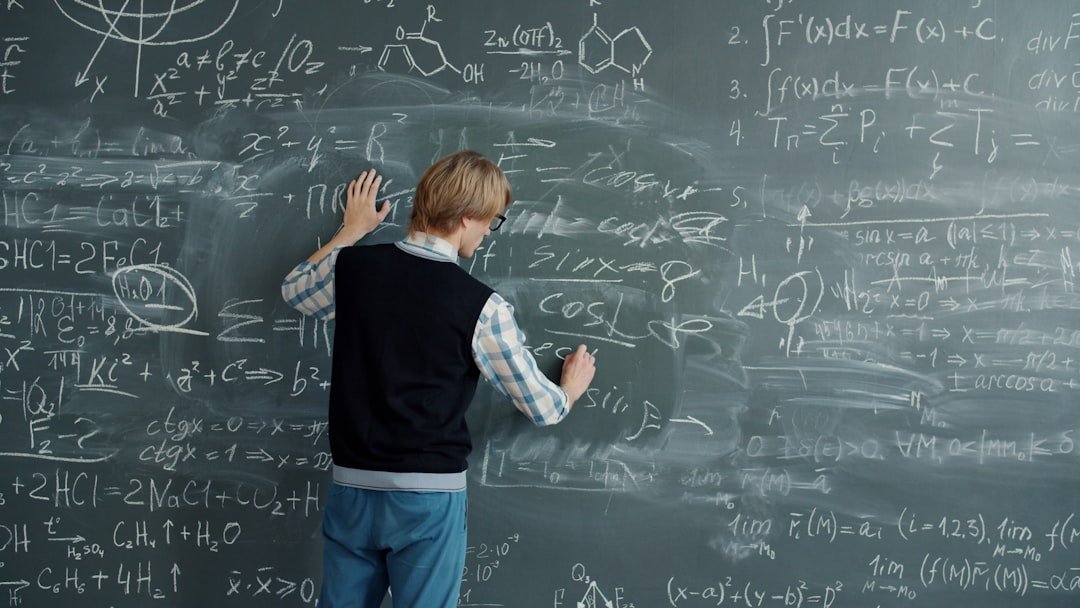
Remember that feeling in high school or college calculus class? You’re staring at a problem on the board—a proof that seems to twist in on itself, full of symbols that feel more like ancient runes than numbers. Your brain hurts. You can follow the professor's steps, but the why—the creative leap required to even start—feels like pure magic. For decades, that magical spark of insight has been a uniquely human domain.
AI has always been a bit of a paradox here. It can perform trillions of calculations per second, beating grandmasters at chess and Go, yet it stumbles on the kind of abstract reasoning needed to solve a novel math problem. Previous models like GPT-4 were impressive, sure. They could retrieve and reassemble known proofs from their vast training data, but ask them to create something genuinely new, and the cracks would appear. They were like brilliant students who had memorized every textbook but couldn't solve a single problem that wasn't in the answer key.
Now, the whispers around OpenAI's next-generation model, GPT-5, are getting louder. The big claim? A fundamental breakthrough in reasoning. OpenAI suggests GPT-5 can “think” more deeply, applying careful analysis where it’s needed most. This isn't just about being a faster calculator; it's about imbuing AI with the ability to reason, strategize, and perhaps even achieve that elusive spark of mathematical insight. So, let's unpack this. Are we on the verge of an AI that can prove the Riemann Hypothesis, or is this just another step up the same old ladder?
The Great Wall of Mathematics: Why AI Has Always Stumbled
To really get what's so special about the GPT-5 claim, we first need to understand why math has been such a tough nut for AI to crack. It boils down to a simple but profound difference: calculation versus reasoning.
A calculator performs a defined set of operations. You give it 2+2, and it executes a pre-programmed function to give you 4. It’s incredibly fast and accurate, but it has zero understanding of what "two" or "plus" even means. Early AI was a lot like this—brute-forcing solutions but never truly understanding the problem.
Modern language models are different. They work by predicting the next most likely word in a sequence based on patterns in their training data. This is why GPT-4 can write a sonnet or a piece of code—it has seen countless examples and is a master of mimicry. But a mathematical proof isn't just a sequence of likely symbols. It's a rigid, logical argument where every single step must be verifiably true and follow from the last.
The Problem of "Good Enough"
For an AI, a "hallucination" in a creative story is a quirky feature. In a mathematical proof, it's a catastrophic failure. Previous models would often produce proofs that looked plausible but contained subtle (or not-so-subtle) logical flaws. They might skip a crucial step, misapply a theorem, or make an intuitive leap that simply isn't valid.
Think of it this way:
- Calculation: Following a recipe exactly as written.
- Pattern Matching (GPT-4): Looking at thousands of finished cakes and trying to guess the recipe. You might get close, but you'll probably miss a key ingredient.
- True Reasoning (The Goal for GPT-5): Understanding the chemistry of baking so you can invent a completely new recipe from scratch.
This is the wall AI has been hitting. It could mimic the form of a proof but lacked the underlying logical rigor to guarantee its correctness or to forge a new path through uncharted mathematical territory.
What’s Supposedly Different About GPT-5's Brain?
The buzz around GPT-5 centers on its purported ability to move beyond simple pattern matching. The claim of "thinking more deeply" suggests a more deliberate, multi-step reasoning process. While OpenAI keeps its architecture under wraps, we can speculate on what this might look like under the hood.
One popular idea in AI research is a "System 2" approach, inspired by human psychology.
- System 1 Thinking: This is your gut reaction. It's fast, intuitive, and automatic. For an AI, this is like spitting out the most statistically likely answer.
- System 2 Thinking: This is slow, deliberate, and analytical. It's when you consciously stop, check your work, and think through a problem step-by-step.
It's possible GPT-5 has a built-in mechanism that allows it to do something similar. Instead of just generating the next line of a proof, it might:
- Generate a potential step.
- Pause and critique that step. Does this logically follow? Is it a valid application of a known theorem?
- Explore multiple possible paths before committing to one.
- Verify its own work as it goes, essentially "showing its work" to itself.
This would be a game-changer. It’s the difference between blurting out the first answer that comes to mind and taking the time to carefully construct an airtight argument. It moves the AI from being a clever parrot to a methodical problem-solver.
So, Can It Actually Prove Something New?
This is the billion-dollar question. It's one thing to solve problems that already have known solutions; it's another entirely to prove a theorem that has stumped the greatest human minds for centuries.
Successfully proving a long-standing conjecture like the Collatz Conjecture or Goldbach's Conjecture would be the ultimate proof-of-concept. It would mean the AI isn't just rearranging human knowledge—it's generating new knowledge. We're not there yet, and we should manage our expectations. The first major breakthroughs will likely be more modest but no less significant.
For instance, GPT-5 could become an invaluable partner for human mathematicians. A researcher could outline a proof strategy and have the AI fill in the tedious logical gaps, verifying each step with perfect accuracy. This could dramatically accelerate the pace of discovery.
The Bridge to Formal Verification
Another huge area is formal verification. This is a field where mathematical proofs are translated into a computer language (like Lean or Isabelle/HOL) that can be checked by a machine with 100% certainty. The problem? Writing these formal proofs is incredibly difficult and time-consuming for humans.
An AI like GPT-5 could act as the ultimate translator, taking a mathematician's high-level, human-language proof and converting it into a formally verified, machine-checkable format. This would eliminate the possibility of human error and raise the standard of certainty in mathematics to a whole new level.
Beyond the Blackboard: What an AI Mathematician Means for Us
If GPT-5 (or its successors) truly cracks advanced reasoning, the impact will be felt far beyond academic journals. This kind of logical powerhouse has staggering real-world applications.
- Cryptography: The security of everything from your bank account to national secrets relies on mathematical problems that are easy to create but incredibly hard to solve. An AI that can reason at this level could potentially find vulnerabilities in existing encryption standards or, on the flip side, help design new, unbreakable ones.
- Science and Engineering: From modeling the complexities of climate change to designing more efficient airplane wings or discovering new materials, progress is often bottlenecked by our ability to solve incredibly complex equations. An AI partner could help us model and understand systems that are currently beyond our computational grasp.
- Software Development: Imagine an AI that can analyze a piece of code and formally prove that it is free of bugs or security vulnerabilities before it's ever deployed. This could prevent catastrophic failures in critical infrastructure, from power grids to financial markets.
The role of the human expert won't disappear. Instead, it will evolve. We'll move from being the ones doing the grinding calculations to being the ones asking the right questions. The mathematician becomes the creative director, guiding the AI's immense logical power toward the most interesting and important problems.
Should We Trust an AI's Proof? The Road Ahead
Let's say GPT-5 produces a 500-page proof for a major theorem. It's so complex that no single human can hold all the steps in their head at once. Do we just take its word for it?
This is a critical challenge. The answer can't be blind faith. The solution will likely involve the very tools the AI helps create. The proof would need to be formally verifiable, broken down into machine-checkable components that confirm its validity beyond any doubt. Transparency will be key; the AI must be able to explain its reasoning in a way that humans can interrogate and understand.
We're standing at a fascinating crossroads. The quest to build an AI that can reason mathematically isn't just about solving esoteric problems. It's about pushing the boundaries of what we consider "thinking" and building a tool that can help us comprehend the universe in a deeper way. GPT-5 might not be the final answer, but its focus on deliberate, careful reasoning is a massive step in the right direction. It's the beginning of a new partnership, one where human intuition and AI's logical rigor team up to unlock the next great era of discovery.