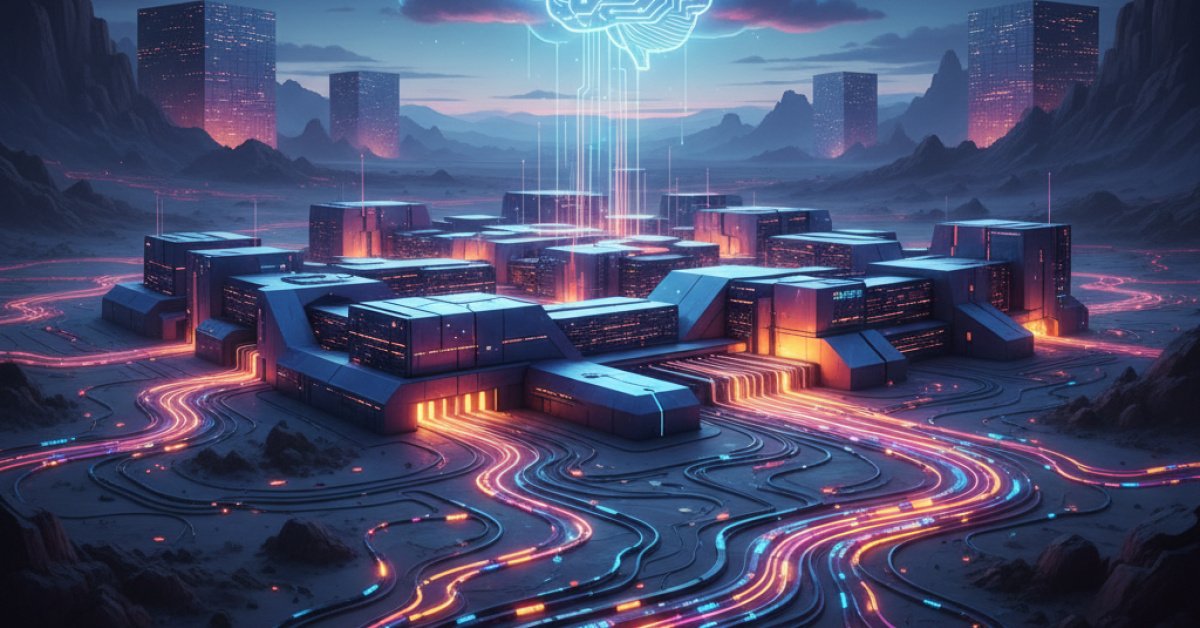
Have you ever stopped to think about where "the cloud" actually lives? Or where ChatGPT goes to "think"? We talk about AI and data as if they're these magical, weightless things floating around in cyberspace. But the truth is, they have a physical home.
And lately, those homes have gone from being quiet suburban office parks to sprawling, city-sized industrial complexes that cost billions of dollars to build.
It’s a bit of a shock when you really dig into it. We're in the middle of an unprecedented AI gold rush, and the biggest players—think Google, Microsoft, Amazon, Meta—are in a frantic race. But they're not just competing with code and algorithms. They're in a full-blown construction war, building the physical foundations for AI dominance. And the price tag and the sheer size of these projects are just staggering.
So, What's Fueling This Building Frenzy?
In a word: Generative AI.
Think about the difference between loading a simple webpage and asking an AI to write a poem or create a photorealistic image of an astronaut riding a horse. The first task is like flipping on a light switch. The second is like powering up a small factory.
The large language models (LLMs) and image generators we're all playing with are incredibly power-hungry. They require a mind-boggling amount of computational power to train and to run. We're talking about processing trillions of data points just to answer a single question.
Your standard data center from five years ago just can't handle that kind of workload. It’s like trying to run a modern video game on a computer from the 90s. It just won't work. So, to keep up, tech giants are building a new generation of facilities from the ground up, specifically designed for the brute force demands of AI.
These Aren't Your Dad's Server Rooms
When I say "data center," you might picture a few racks of humming servers in a cold, windowless room. We need to completely throw that image out the window.
The new standard is the "hyperscale" data center, and the name says it all. These are colossal structures. We’re talking about campuses that cover hundreds of acres, with individual buildings stretching over a million square feet. That’s the size of 20 football fields under one roof.
And the cost has exploded right alongside the size.
Not long ago, building a large data center might have set a company back a few hundred million dollars. That was considered a massive investment. Today? The starting price for a top-tier, AI-ready data center is casually hitting one billion dollars. And that's just for a single facility. Many of these companies are planning to build dozens of them.
What Makes Them So Insanely Expensive?
So, where does all that money go? It's not just concrete and steel. The real cost is what's inside.
Think of it like building a high-performance race car. The chassis is expensive, but the real money is in the engine, the electronics, and the cooling systems.
- The "Brains": The most significant cost is the hardware itself. These centers are packed with tens of thousands of specialized processors, particularly GPUs (Graphics Processing Units) from companies like NVIDIA. A single one of these chips can cost tens of thousands of dollars. Now multiply that by an entire warehouse.
- The Power Grid: You can't just plug these buildings into a standard wall outlet. They consume an unbelievable amount of electricity—often as much as a small city. This requires building dedicated substations and forging major deals with utility providers.
- The Cooling Systems: All those chips running 24/7 generate an immense amount of heat. If they overheat, they fail. So, a huge chunk of the budget goes into sophisticated cooling infrastructure, from industrial-scale air conditioning to complex liquid cooling systems that pipe water directly to the servers.
This isn't just about scaling up old designs; it's a fundamental shift in what a data center even is. It’s a move from a storage facility to a high-performance computing factory.
A Footprint You Can Literally See
The battle for AI dominance is leaving a very real, very large footprint on our planet. This isn't just a metaphor. These massive construction projects are reshaping landscapes.
Tech companies are buying up huge swaths of land in places where power is cheap and land is available, often in rural or semi-rural areas. Quiet towns are suddenly finding themselves home to one of the most advanced industrial sites on Earth.
And the resource consumption is something we really need to talk about. The electricity demand is the most obvious one. As we build more of these power-hungry AI factories, it puts a real strain on our electrical grids.
But there's also the water. Many of these cooling systems use a tremendous amount of water through evaporation to keep the servers from melting down. In an era of increasing droughts and water scarcity, this is becoming a serious point of contention.
It's a strange paradox, isn't it? The most advanced, seemingly ethereal technology we've ever created is completely dependent on some of the most basic, physical resources we have: land, power, and water.
As we continue to push the boundaries of what AI can do, we're also pushing the boundaries of what our physical infrastructure can support. The invisible world of AI is being built with very visible, very expensive, and very resource-intensive steel, silicon, and concrete. This building boom is just getting started, and it’s fundamentally changing the physical landscape of our world, one billion-dollar data center at a time.