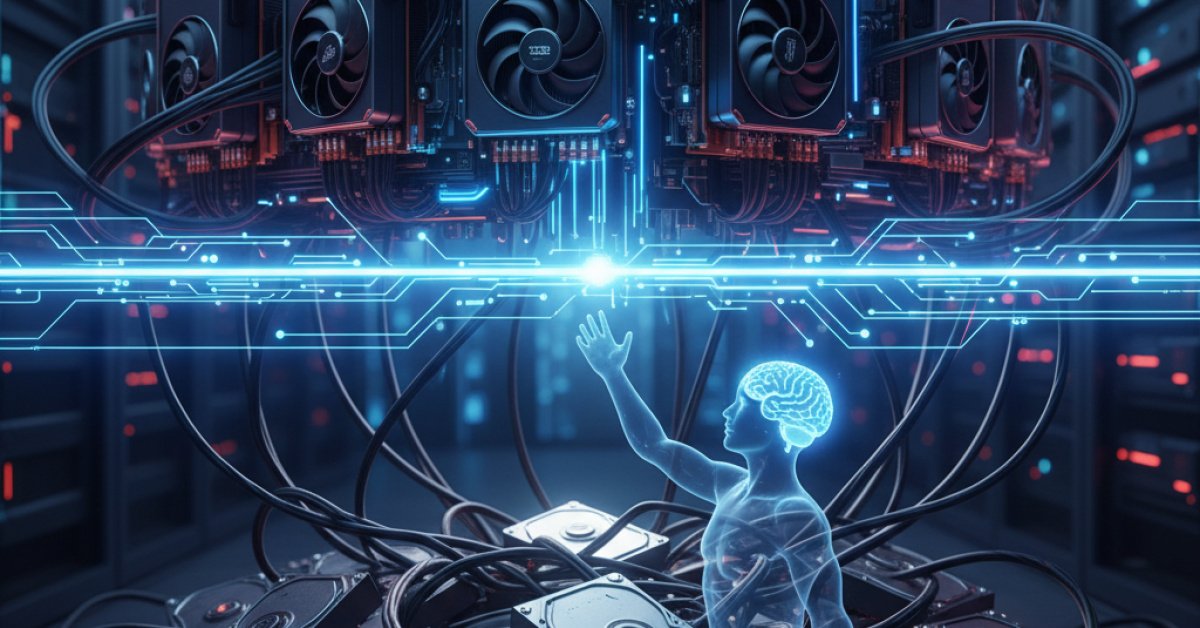
You’ve invested a fortune in cutting-edge GPUs. Your AI models are sophisticated, your algorithms are brilliant, and your team is ready to change the world. But there’s a silent performance killer lurking in your data center, and it’s probably not what you think. It's your storage.
Think of it like owning a fleet of Formula 1 cars but forcing them to refuel using a garden hose. The raw power is there, but it’s being starved at the most critical moment. That’s exactly what’s happening when we pair powerful AI infrastructure with traditional Hard Disk Drives (HDDs). The game has changed. Data that once sat gathering digital dust in "cold storage" is now the lifeblood of AI, constantly being accessed, analyzed, and used to train smarter models.
This isn't just a minor inconvenience; it's a fundamental bottleneck that's holding back the entire AI revolution. As we push for more accurate models and faster results, we're creating a traffic jam at the data layer. The spinning platters of HDDs, a marvel of mechanical engineering, simply can't keep up with the relentless, parallel demands of modern AI. It’s time for a new approach.
The Old Guard Can't Keep Up: Why HDDs Are Failing AI
For decades, HDDs have been the trusty workhorses of data storage, offering massive capacity at a low cost. They were perfect for archiving data you didn't need to touch very often. But AI has flipped the script. That "cold" data is now scorching hot, and HDDs are feeling the heat.
"Modern AI workloads, combined with data center constraints, have created new challenges for HDDs," explains Jeff Janukowicz, research vice president at IDC. He points out that while HDD manufacturers are bumping up capacity, it often comes at the cost of performance. This performance-per-terabyte is dropping, creating a massive problem for AI tasks that need to read tons of data, and fast.
This is where the concept of "nearline SSDs" is starting to make waves. AI doesn't just need to store data; it needs to access it—simultaneously, from multiple points, with virtually zero delay.
Here’s where the old mechanical design of an HDD hits a wall:
- Latency Kills: The physical act of a read/write head moving across a spinning platter introduces delays. For real-time AI inference, that lag is a deal-breaker.
- IOPS Bottleneck: AI training involves bombarding the storage with countless small, random read requests. HDDs, with their limited Input/Output Operations Per Second (IOPS), simply can't handle this level of concurrent demand.
- Power Hogs: All those moving parts consume a surprising amount of energy and generate significant heat, especially under the constant strain of AI workloads. In a world where data center power is a precious, and expensive, commodity, this is a huge drawback.
Essentially, while HDDs will still have a role for true, deep-archive cold storage, relying on them for the active data that fuels your AI is like trying to win a drag race in a semi-truck. It has the capacity, but it completely lacks the agility and speed you need to win.
The SSD Revolution: More Than Just a Hardware Swap
This isn't just about swapping one box for another. Shifting to a high-capacity, SSD-first strategy is a structural change in how we design data infrastructure for the AI era. According to Roger Corell, a senior director at Solidigm, this shift speaks to the "tectonic shift in the value of data for AI." When data becomes an active asset, the platform it lives on needs a serious upgrade.
High-capacity SSDs bring a trifecta of benefits that directly address the weaknesses of HDDs in an AI context: performance, efficiency, and density.
Feeding the GPU Beast with Blazing Performance
Let's be clear: the goal of any AI infrastructure is to keep the GPUs busy 100% of the time. Every moment a GPU is waiting for data is money down the drain. SSDs eliminate that waiting game. Their solid-state nature means data access is nearly instantaneous, providing the low-latency, high-throughput firehose of data that hungry GPUs crave. This allows for massive parallel processing, which is the cornerstone of training large language models and other complex AI systems.
The Efficiency Game-Changer: Slashing Power and Footprints
This is where the numbers get really interesting. Solidigm and VAST Data partnered on a study to see what storing data at an exabyte scale (that's a billion gigabytes) really looks like. The results are staggering.
To store one exabyte of data, you would need over 40,000 high-capacity HDDs. Thanks to the superior performance of SSDs, which enables more effective data reduction techniques, the same capacity could be achieved with just 3,738 Solidigm SSDs.
The impact on energy is massive. The study found that the SSD-based solution consumed 77% less storage energy. In an AI data center where every watt is accounted for and power purchase agreements are measured in the megawatts, that's not just a saving—it's a strategic advantage. It frees up power that can be reallocated to what really matters: adding more GPUs.
The Density Dividend: 9x the Power in the Same Space
"We’re shipping 122-terabyte drives to some of the top OEMs and leading AI cloud service providers in the world," says Corell. When you start working with that kind of density, the physical footprint of your data center shrinks dramatically.
Corell highlights a "nine-to-one savings in data center footprint" when comparing an all-SSD setup to a hybrid HDD configuration. This is huge for massive hyperscale data centers, but it's arguably even more critical for smaller regional data centers or edge deployments where physical space is at an absolute premium.
That 9x saving isn't just about floor space. It translates to:
- Reduced Capital Costs: You need fewer racks, fewer cables, and less cooling infrastructure.
- Lower Operational Costs: With 90% fewer storage bays to manage and maintain, the ongoing operational overhead plummets.
- Greater GPU Scale: As Corell puts it, "If you’re given X amount of land and Y amount of power, you’re going to use it... why not use it in the most efficient way? Get the most efficient storage possible... and enable greater GPU scale."
There’s even a sustainability angle. A smaller physical footprint means less concrete and steel are needed for construction—materials that account for over 15% of global greenhouse gas emissions. At the end of their life, you're also disposing of 90% fewer drives.
Architecting for the Future: Liquid Cooling and the Memory Wall
The challenges aren't stopping here. As AI models become more complex, we're running up against a "memory wall," making storage architecture a frontline design problem, not an afterthought. The heat generated by these hyper-dense systems is also a major concern.
This is where the next wave of innovation is happening. Solidigm has already launched its fourth generation of QLC (Quad-Level Cell) technology, which balances capacity and cost-efficiency. But they're also tackling the heat problem head-on.
The Solidigm D7-PS1010 E1.S is a perfect example—it's the industry’s first enterprise SSD designed with single-sided direct-to-chip liquid cooling. Developed in collaboration with NVIDIA, it's built to handle the intense thermal loads of next-generation GPU servers without compromising on performance.
"We’re rapidly moving to an environment where all critical IT components will be direct-to-chip liquid-cooled," Corell predicts. "Power limitations, power challenges are not going to abate in my lifetime."
This isn't just about a faster drive; it's about a holistic approach to building AI infrastructure. The organizations that thrive in the coming years will be the ones that stop thinking of storage as a simple commodity. They'll recognize it as a foundational pillar of their AI factory—a critical component that can either unleash or cripple their potential. The move to a high-capacity, hyper-efficient, SSD-first future isn't just an upgrade; it's a necessary evolution to keep pace with the relentless ambition of artificial intelligence.