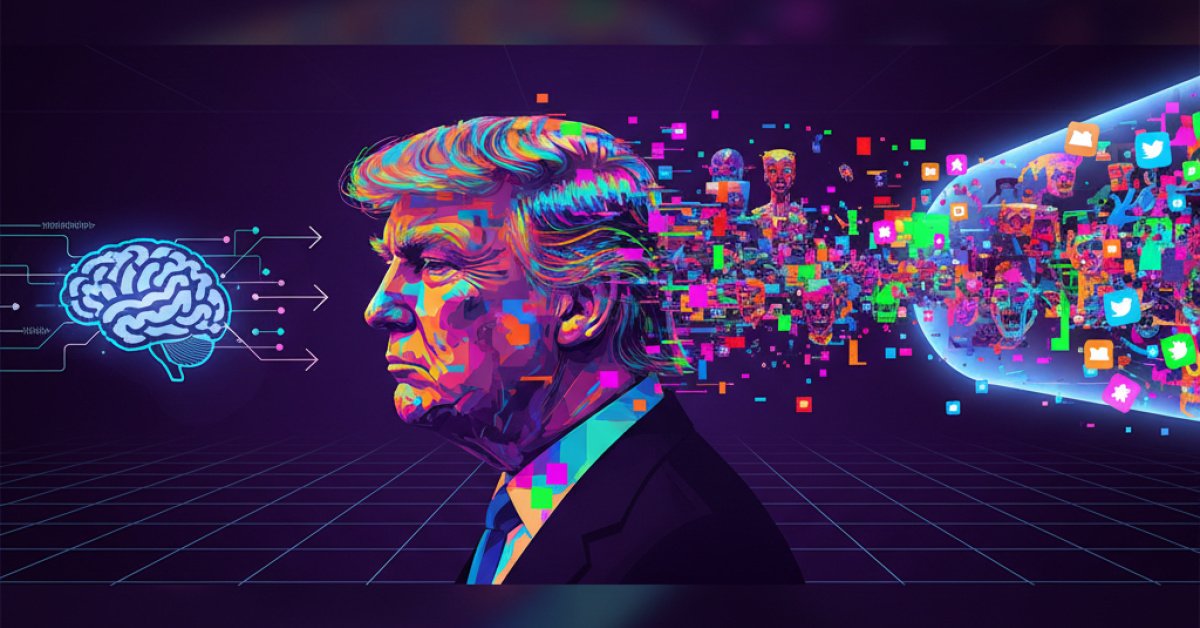
If you’ve scrolled through Donald Trump’s Truth Social feed lately, you might feel like you’ve stepped into a fever dream. One moment, he’s a muscular superhero. The next, he’s a DJ spinning records at a surreal, AI-generated party. You might even see him sitting down with a group of Black voters, all of whom have that slightly-too-smooth, uncanny look that screams "not real."
This isn't your typical campaign content. It's a new, bizarre phenomenon that’s been dubbed "AI slop"—a firehose of low-quality, often nonsensical, AI-generated images and videos. And the presumptive Republican nominee for President of the United States is one of its biggest amplifiers.
It raises a huge question that goes far beyond partisan politics: What in the world is going on? Is this a calculated, next-generation campaign strategy, or is it just the chaotic result of an online ecosystem gone wild? Let's pull back the curtain on how these strange digital creations end up in one of the most-watched social media feeds on the planet.
What Exactly Are We Seeing? The Rise of Political AI "Slop"
Before we dive into the "how," let's get a handle on the "what." The term "AI slop" perfectly captures the essence of this content. It’s often characterized by a few tell-tale signs:
- Visual Oddities: Waxy skin, extra fingers, distorted backgrounds, and a general "off" feeling that our brains can't quite place.
- Bizarre Scenarios: The situations depicted are frequently outlandish, like Trump praying with a glowing Jesus or riding a bald eagle through a lightning storm.
- Inconsistent Messaging: Unlike polished campaign ads, these videos are all over the place, ranging from humorous to reverent to just plain weird.
This isn't the kind of high-end, hyper-realistic deepfake technology that security experts have been warning us about for years. Instead, it’s the output of consumer-grade AI image and video generators, tools that are now accessible to anyone with an internet connection. The result is a flood of content that’s more about speed and volume than quality or coherence. And it’s a perfect fit for the fast-paced, attention-starved world of social media.
The Digital Trail: Who's Making This Stuff?
So, how do these AI-generated videos make their way from some corner of the internet to Trump’s official Truth Social account, which boasts millions of followers? A little digital sleuthing reveals it's not a top-down operation.
The official Trump campaign isn't sitting in a war room storyboarding videos of him as a rock star. Instead, the process is far more organic and, frankly, much harder to control.
It Starts with the Supporters
The vast majority of these AI videos originate from a decentralized network of pro-Trump content creators, meme-makers, and digital activists. These are his most online, most dedicated supporters, who use platforms like X (formerly Twitter), Rumble, TikTok, and Gettr to create and share content.
They use tools like Midjourney, Pika Labs, and Runway to quickly generate videos that praise Trump, mock his opponents, or simply create visually arresting (and strange) content to show their support. For them, it's a form of digital fan art—a way to participate in the movement and get noticed.
The Amplification Engine
The crucial second step is amplification. Once a video gains a bit of traction within these pro-Trump online communities, it has a chance of being seen by someone with a bigger platform. Eventually, some of these videos bubble up to the top.
And the biggest amplifier of all is Donald Trump himself.
He frequently "ReTruths" (the platform's version of a retweet or share) content directly from his supporters. He isn't the creator; he's the curator. By sharing a video, he instantly blasts it out to his massive audience, giving it a stamp of legitimacy it never had before. This creates a powerful feedback loop:
- A supporter creates a piece of AI content.
- They post it, hoping to get noticed.
- Trump sees and "ReTruths" it.
- The creator gets a massive signal boost, encouraging them and others to make even more content.
This system allows Trump to maintain a constant stream of fresh, pro-Trump content on his feed without his campaign having to lift a finger—or spend a dime.
A Calculated Strategy or Pure Online Chaos?
The billion-dollar question is whether this is an intentional strategy or just Trump being Trump. The answer is likely a bit of both. We can look at this through two different lenses.
Theory 1: The Master of Chaos
Donald Trump’s political brand has always been built on disruption, media dominance, and a flair for the unpredictable. His 2016 campaign harnessed the chaotic energy of social media better than anyone, and this feels like an evolution of that playbook.
From this perspective, the "slop" serves several purposes:
- It Dominates the Conversation: Good, bad, or just plain weird, the content gets people talking. News outlets (like this one!) write articles about it, and it generates endless engagement online.
- It’s Authentic to His Base: Polished, focus-grouped campaign ads can feel sterile. A bizarre, fan-made AI video feels more grassroots and authentic to his supporters. It’s their culture, not a consultant’s.
- Plausible Deniability: Because the campaign isn't officially creating these videos, they can easily distance themselves from any that cross a line. They can simply say, "He just reposted something a supporter made."
This approach keeps his feed active and his supporters engaged, all while operating in a gray area that confounds traditional political analysis.
Theory 2: The Grassroots Curator
The other view is less about a grand strategy and more about a simple dynamic. Trump enjoys seeing positive, flattering, and powerful depictions of himself. His supporters love creating them. He sees them, he likes them, he shares them.
In this light, he's acting less like a political strategist and more like a celebrity curating his own fan page. It makes his supporters feel seen and valued, strengthening their bond with him. He’s not just their candidate; he’s part of their online community. This bottom-up energy is something that traditional campaigns struggle to replicate, and for the Trump movement, it’s a core part of its identity.
The Slippery Slope: Normalizing a Distorted Reality
While it might be easy to dismiss these videos as harmless, silly fun, their proliferation in a presidential campaign has some pretty serious implications. We're wading into uncharted territory, and the long-term effects are deeply concerning.
The biggest danger is the slow and steady erosion of our shared reality. When a major political figure constantly shares AI-generated content, it begins to normalize the idea that what we see online may not be real. This blurs the lines and lowers our collective guard.
Think about it: If you get used to seeing dozens of fake-but-positive videos of your preferred candidate, will you be able to spot a sophisticated, malicious deepfake designed to damage their reputation? The constant exposure to "friendly fakes" could desensitize us to the threat of "enemy fakes." It creates a media environment where everything is questionable, and people retreat to believing only what confirms their existing biases.
This is the classic "liar's dividend," where bad actors can dismiss real evidence of wrongdoing as just another "deepfake," and an exhausted public no longer knows what to believe.
Welcome to the First True AI Election
Whether it's by design or by accident, the Trump campaign has stumbled into a new form of political communication. It's messy, unpredictable, and completely different from anything we've seen before. And you can bet that other campaigns around the world are taking notes.
This is a clear signal that the 2024 election, and every election after it, will be fought on a new battlefield. It's no longer just about fighting misinformation in text; it's about authenticating reality itself. For us as voters and consumers of information, it means we need a new set of skills. A healthy dose of skepticism is no longer optional; it's essential.
The world of AI-generated political slop is strange and often comical, but it's also a window into the future of campaigning. It’s a future where the lines between reality and fiction are increasingly blurry, and the loudest, most persistent narratives—no matter how bizarre—can win the day. Navigating it will be one of the defining challenges of our time.