When you picture a factory robot, what comes to mind? Probably a giant, clumsy arm, bolted to the floor, doing the exact same thing over and over. It picks up a part, welds it, and puts it down. Rinse and repeat, a thousand times a day.
For decades, that’s pretty much what they’ve been good for: the simple, repetitive stuff.
But what about the tasks that require a bit of… finesse? The kind of work that needs a human touch, like polishing a curved surface or carefully assembling a delicate component. Traditional robots are terrible at that. You can’t just program “feel” or “intuition” into a machine.
Or can you?
A fascinating startup in China called AgiBot is taking a completely different approach. And honestly, it’s one of those ideas that sounds a little backward at first, but the more you think about it, the more brilliant it seems. They’re building smarter, more capable robots by using… a small army of human workers.
Let me explain.
So, How Are Humans Teaching These Robots?
Imagine trying to teach a toddler how to build a LEGO castle. You wouldn't just write down a long list of instructions, right? Of course not. You’d sit down with them, pick up a block, and show them. "This piece goes here," you'd say, snapping it into place. They watch, they mimic, and eventually, they learn.
That’s basically what AgiBot is doing, but with advanced AI and robotic arms.
Instead of spending months writing complex code for a single task, they have human operators "drive" the robots themselves. A person sits at a control station, using joysticks and sensors to guide the robot through a task, like sanding a piece of wood or applying glue.
The AI is watching this whole time. It’s not just recording the movements; it’s learning the nuances. It’s figuring out the right amount of pressure to apply, the optimal speed, and how to adjust to slight variations in the material. The human operator is essentially the teacher, and the robot is the student, learning by imitation.
After the AI has watched the human do the task a few dozen times, it starts to get the hang of it. It can then try to do it on its own, and the human operator can step in to make tiny corrections. It’s a feedback loop that gets the robot from clumsy apprentice to skilled master in a surprisingly short amount of time.
Why Not Just Code It the Old-Fashioned Way?
This is the part that really clicked for me. The old way of programming a robot is incredibly rigid. You have to account for every possible variable, and if anything changes—even slightly—the whole program can break.
Think about polishing a car door. Every door is almost the same, but not quite. A human worker instinctively adjusts for tiny imperfections, applying a little more pressure here, a little less there. Coding that kind of adaptability is a nightmare.
But by learning from a human, the AI develops a kind of "feel" for the job. It’s not just following a script; it’s executing a skill.
Here’s why this approach is so powerful:
- Speed: Training a robot this way can take hours or days, not the weeks or months it might take a team of engineers to code the same task from scratch.
- Flexibility: Once the AI model learns a general skill, like "polishing," it can apply that knowledge to different objects with minimal retraining. It’s much more adaptable.
- Complexity: It opens the door for automating tasks that were previously considered "too human" for robots—jobs that require dexterity and a sense of touch.
It’s a clever shortcut that bypasses a ton of engineering headaches. Instead of trying to build human-like intelligence from the ground up, they’re essentially letting humans transfer their own skills directly to the machine.
What This Means for the Future of 'Made in China'
Now, let's zoom out a bit. This isn't just a cool tech story; it has huge implications, especially for a manufacturing powerhouse like China.
For years, China’s advantage was its massive, low-cost workforce. But that’s changing. Labor costs are rising, and the country is looking to move up the value chain, producing more complex, high-quality goods. To do that, they need more sophisticated automation.
Companies like AgiBot are right at the center of this shift. They’re not just creating robots to replace workers on an assembly line. They're creating tools that can augment human skill, automating the difficult, delicate work that keeps factories competitive.
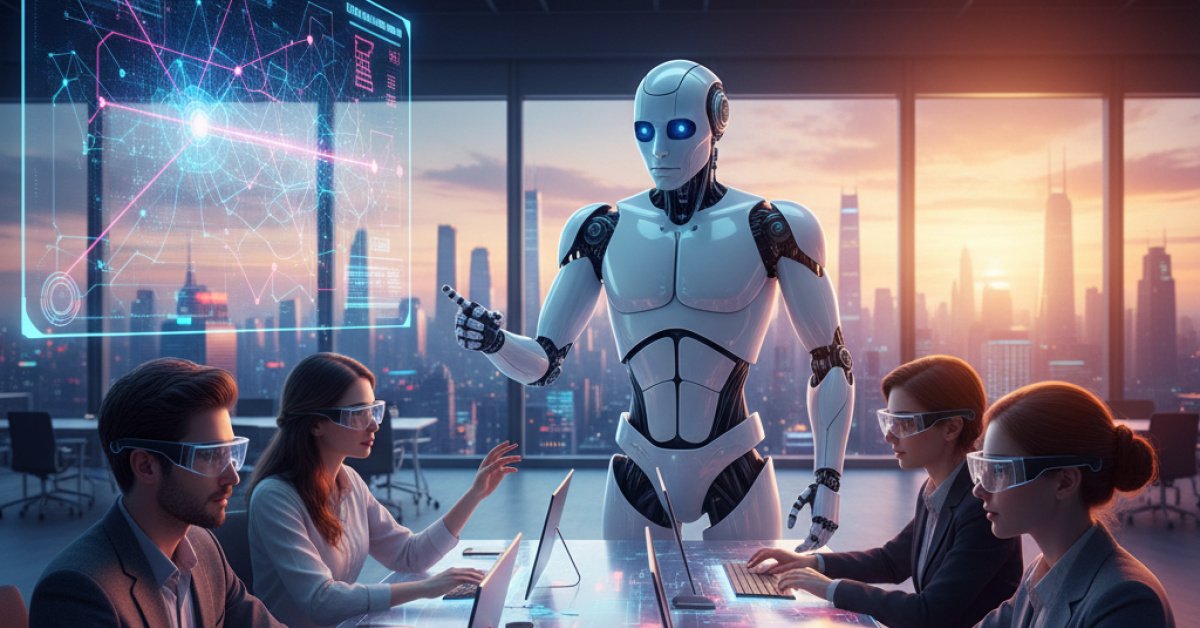
This is a different kind of automation. It’s not about getting rid of people entirely. It’s about changing their role. The factory worker of the future might not be the one doing the physical labor, but the one teaching the robot how to do it. They become trainers, supervisors, and problem-solvers for a fleet of AI-powered machines.
It’s a fascinating glimpse into a future where human experience and artificial intelligence work hand-in-hand. We often talk about AI in abstract terms, but this is where the rubber meets the road—or in this case, where the robotic arm meets the factory floor. And it seems the key to building smarter machines might just be remembering to keep a human in the loop.