Have you ever noticed how your phone battery just doesn't hold a charge like it used to? After a couple of years, you're lucky to make it to lunchtime. Now, imagine that same problem, but your phone is a two-ton electric car, and the battery costs a fortune to replace.
That's the reality hitting millions of people in China right now.
Let me tell you about a guy named Wang Lei. Back in 2016, he was an early adopter, one of the first in his Beijing neighborhood to buy an electric vehicle. It was a local Chinese brand, and with government subsidies, it felt like a smart, forward-thinking move. He was proud to be part of the future.
Fast forward to 2025. His car’s range had shriveled. The battery was old, tired, and out of warranty. Replacing it was too expensive, so he decided to sell. He found a local recycler on Douyin (China's TikTok), and the next day, someone showed up, picked up his car, and paid him about 8,000 yuan. It was almost too easy.
Wang's story isn't unique. It's a preview of a massive problem that's been quietly building for a decade. China went all-in on EVs, and it worked. They successfully put tens of millions of them on the road. But they’re just now starting to grapple with the second half of that equation: What do you do when all those cars—and their massive batteries—die?
A Tidal Wave of Batteries Is on the Horizon
Let's be clear: the scale of this is staggering. By late 2025, nearly 60% of all new cars sold in China were electric or plug-in hybrids. That’s an incredible achievement.
But here’s the catch. Like the battery in your phone, an EV battery degrades over time. Industry folks generally agree that once a battery's capacity drops below 80% of its original strength, it's pretty much done for car use. It charges slower, the range gets shorter, and safety can become a concern.
And that 80% cliff is fast approaching for a whole generation of EVs.
One research group, EVtank, estimates that China will have to deal with 820,000 tons of retired EV batteries this year alone. By 2030, that number is expected to climb toward a million tons annually. Think about that. A million tons of complex, heavy, and potentially hazardous materials. Every single year.
The Wild West of Battery Recycling
So, what happens to these old batteries? In a perfect world, they go one of two ways.
- A Second Life (Cascade Utilization): The battery packs that are still in decent shape can be repurposed. They might not be powerful enough for a car anymore, but they're perfect for less demanding jobs, like storing energy for the power grid or running low-speed vehicles like electric scooters.
- The Full Breakdown (Recycling): For batteries that are truly at the end of their life, they're dismantled. Specialized facilities break them down to their core components to recover valuable metals like lithium, nickel, cobalt, and manganese. These precious materials can then be used to build brand-new batteries.
Both of these processes, when done right, are fantastic. They’re a key part of making EVs truly sustainable. The problem is, doing it right is expensive. It requires serious investment in technology, safety protocols, and environmental protection.
And that’s where things get messy. China’s battery recycling industry has exploded. By the end of last year, there were nearly 180,000 companies in the business. But most of them are tiny, new, and completely unregulated.
This has created a massive "gray market"—a network of small, unlicensed workshops that can offer people like Wang Lei a better price for their old cars. How? By cutting every corner imaginable.
What Happens When Recycling Goes Wrong
I spoke with a guy named Gary Lin, who worked in several of these unlicensed shops for a couple of years. His stories are pretty eye-opening.
He said these places operate with a "brute-force" mentality. Workers literally crack open the battery packs, pull out the individual cells, and try to reassemble them into refurbished packs. Sometimes, he said, they even sell these cobbled-together batteries as "new" to unsuspecting buyers.
When the batteries are too far gone, they just crush them and sell the material by weight to metal extractors. The scariest part? Gary mentioned that the wastewater used to soak the batteries often gets dumped straight into the sewer. We're talking about a toxic soup of heavy metals and chemicals.
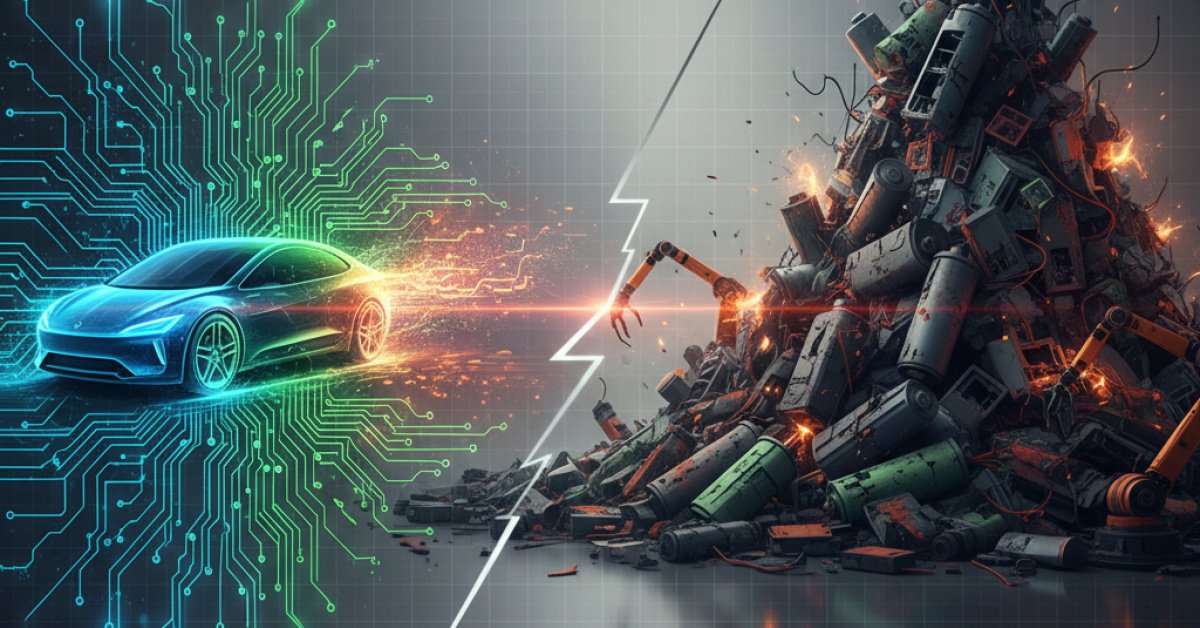
This isn't just an environmental nightmare; it's a huge safety risk. Poorly handled lithium-ion batteries can easily catch fire or explode. The gray market is creating a ticking time bomb, both for public health and safety.
The Big Players Are Stepping In, But Is It Enough?
The Chinese government isn't blind to this. They've been trying to formalize the industry, creating "white lists" of approved, certified recyclers. So far, there are 156 companies on that list. It's a start, but they're struggling to keep up with the sheer volume of batteries pouring into the gray market.
The real hope might lie with the companies that built the cars and batteries in the first place. Giants like BYD (a huge car and battery maker), Geely (another major automaker), and CATL (the world's biggest EV battery manufacturer) are starting to build their own recycling networks.
And it makes perfect sense. As one battery engineer told me, "No one is better equipped to handle these batteries than the companies that make them." They understand the chemistry, they know how the packs are constructed, and they have a direct use for the recovered materials.
- CATL, through its subsidiary Brunp, has already built a massive recycling system that can process over 270,000 tons of batteries a year with an incredible 99% recovery rate for key metals.
- BYD is running its own recycling operations and partnering with specialists.
- Geely is building a whole "circular manufacturing" system to disassemble old cars and reuse everything from the metals to the batteries.
The goal for these companies is to create a "closed loop," where the materials from an old battery go directly into making a new one. That's the dream.
The Problem of the Ghost Brands
But here's a wrinkle in that plan. What about all the EV companies that didn't make it?
The EV gold rush in China was intense. Over the past five years, more than 400 smaller EV startups have gone bankrupt, victims of a brutal price war. That leaves a lot of "orphan" cars on the road.
If you own an EV from a company that no longer exists, you can't just go back to the dealer for a take-back program. You're on your own. And for many of those owners, that sketchy, high-paying workshop on the edge of town is going to look like the best—and maybe only—option.
China is at a critical juncture. It's the first country to face the end-of-life EV problem at this scale, and how it handles this challenge will be a lesson for the rest of the world. Building a comprehensive system that can track, reuse, and safely recycle every single battery is no longer a "nice to have." It's an absolute necessity.
Because if we've learned anything, it's that building the future of transportation is only half the battle. The other half is figuring out how to clean up after it.