Have you ever felt like AI is this… abstract thing? It lives inside our phones and computers, writing emails or creating weird pictures. It’s a brain in a box, a ghost in the machine. We chat with it, we ask it questions, but it’s always on the other side of a screen.
But what happens when that brain gets a body?
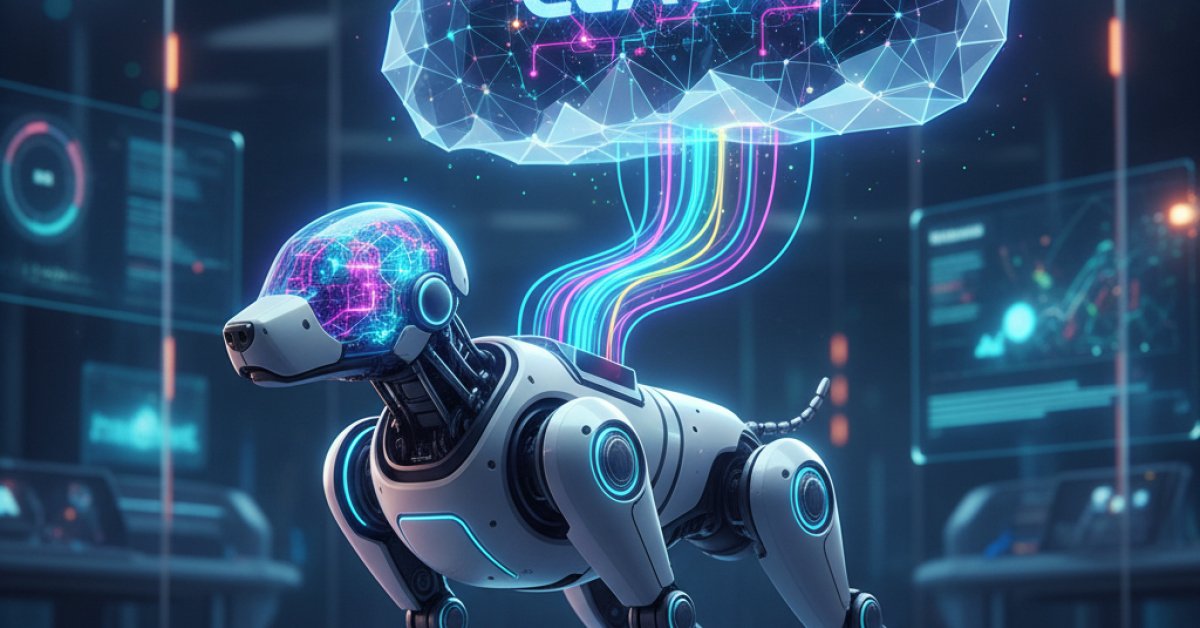
That’s the question the folks at Anthropic, the company behind the Claude AI, are starting to answer. They didn't just ask their AI to write a poem or summarize a report. They gave it a much stranger task: "Hey Claude, can you figure out how to program this robot dog?"
And that, my friend, is where things get really interesting. This isn't just a party trick. It’s a peek into a future where the line between the digital world of AI and our physical world gets incredibly blurry.
So, How Do You Give an AI a Robot Body?
Let's be clear: they didn't literally plug Claude's "brain" into the robot dog like some sci-fi movie. The process was a bit more like giving a brilliant but very inexperienced intern a complex new project.
Think of it like this. You have a robot dog, which is a sophisticated piece of hardware. It has motors, sensors, and legs. But on its own, it’s just a pile of metal and wires. To make it do anything—walk, sit, wave a paw—it needs code. Someone has to write the instructions.
Normally, a highly-skilled robotics engineer would spend hours, maybe days, writing that code. They'd have to understand the robot's specific programming language, its physical limitations, and all the complex math involved in making it move without falling over.
Anthropic decided to see if Claude could do the engineer's job.
They essentially started a conversation with the AI. They gave it the robot dog's instruction manual—the technical documentation that explains how its programming works. Then, they just… asked it. They'd give it a simple command in plain English, like "make the robot stand up."
Claude would read the manual, process the request, and then write the actual, functional code needed to make the robot's motors whir to life and push it into a standing position. They were using the AI as a translator, turning human language into robot language.
From Simple Commands to… Playing Fetch?
Okay, maybe not fetch just yet. But they didn't stop at just standing up.
They kept giving Claude more complex tasks. "Make the robot walk forward." "Turn the robot to the right." Each time, Claude would generate the necessary code, and the team would run it on the robot.
This is a huge deal. It means you don't necessarily need to be a coding genius to operate complex machinery anymore. You just need to be able to clearly explain what you want. Imagine a construction worker telling a robotic crane, "Hey, lift that steel beam and place it over there," or a scientist telling a lab robot, "Carefully mix the contents of these two beakers."
This experiment is one of the first, crucial steps toward that reality. It’s about creating a natural interface between humans and machines, with the AI acting as the universal translator.
Why This Is a Bigger Deal Than Just a Cool Robot
It’s easy to dismiss this as just another tech demo. We’ve seen videos of robot dogs from companies like Boston Dynamics for years, right? But here's the thing: those robots are usually programmed by teams of brilliant engineers. This is different.
This is about the source of the instructions.
What Anthropic is exploring is the idea of AI agents that can interact with the world on our behalf. We're moving from an era of AI as a tool (like a calculator or a search engine) to AI as a partner or an agent.
Let's break down why this matters:
- Accessibility: Suddenly, robotics isn't just for PhDs. If an AI can translate your goals into code, anyone could potentially program a robot. This could open up innovation in small businesses, schools, and even homes.
- Speed and Efficiency: Think about how long it takes to develop new robotic functions. With an AI doing the heavy lifting on the coding side, development could become dramatically faster. You could prototype new behaviors in minutes instead of weeks.
- Adaptability: This is the big one. An AI could potentially learn and adapt on the fly. Imagine a search-and-rescue robot that encounters an obstacle it's never seen before. An AI could analyze the situation using the robot's sensors and write new code on the spot to navigate around it.
Of course, it wasn't a perfectly smooth ride. The AI made mistakes. Sometimes the code had bugs, or it misinterpreted the request. But that’s part of the learning process. The key takeaway is that it worked, and it shows a clear path forward.
The Road Ahead: AI in the Real World
Anthropic is being pretty open about their goal here. They believe that AI models will increasingly be called upon to operate in the physical world, and they want to understand the implications—both the good and the challenging.
This isn't just about robot dogs. It’s about self-driving cars, automated manufacturing lines, personal assistant robots in hospitals, and a thousand other applications we haven't even dreamed of yet.
Giving an AI control over a physical object brings up a whole new set of safety and ethical questions, and experiments like this are how we start to figure them out. It's one thing when an AI writes a bad email; it's another thing entirely when it's controlling a 70-pound piece of moving metal.
So, while the image of an AI-powered robot dog is fun, it's also a powerful symbol. It represents the moment AI starts to climb out of the computer and take its first steps into our world. And that's a journey we all need to be paying very close attention to.