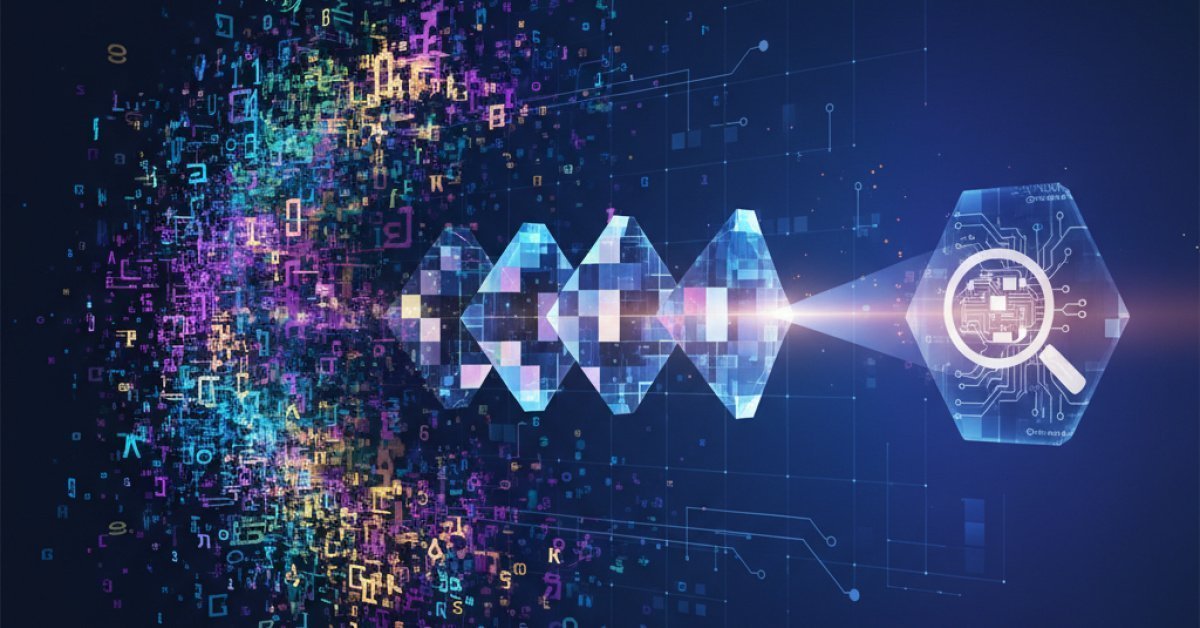
What if the best way for an AI to read a book wasn't to process the words, but to simply look at the pages? It sounds a little backward, right? For years, the world of large language models (LLMs) has operated on a fundamental assumption: text is text, and images are images. Processing text has always been seen as more efficient, a compact and direct way to feed information into a model's digital brain.
But the AI research company DeepSeek just decided to flip that entire assumption on its head. They’ve released a new open-source model that does something radical: it compresses text by turning it into a picture. And it’s not just a neat party trick—it’s up to 10 times more efficient than traditional methods.
This isn't just another incremental update. It's a fundamental challenge to how we build and think about AI. The implications could completely reshape the race for larger context windows and solve some of the most frustrating problems that have plagued AI development for years. Let's break down what DeepSeek did and why it has people like OpenAI co-founder Andrej Karpathy rethinking everything.
The Paradigm Inversion: Seeing Text is Better Than Reading It
For the longest time, multimodal LLMs that can handle both text and images have treated vision as a clunky, expensive add-on. If you wanted to feed an AI 10,000 words, giving it the raw text was vastly more efficient than showing it an image of that text. The image would take up far more "token" space, which is the currency of an AI's attention span.
DeepSeek-OCR inverts this. The researchers found a way to make visual representations of text a super-efficient compression tool. Think of it like this: instead of meticulously typing out every word from a 500-page report, you just take a high-resolution, cleverly compressed snapshot of each page. You capture not just the words, but their layout, formatting, and context—all while using a fraction of the space.
In their technical paper, the DeepSeek team put it plainly, stating their model achieves a "paradigm inversion." The AI community is taking notice. AI researcher Jeffrey Emanuel analyzed the paper and noted, "10k words of English would take up far more space in a multimodal LLM when expressed as intelligible pixels than when expressed as tokens...But that gets inverted now."
This shift is so profound that Andrej Karpathy mused, "Maybe it makes more sense that all inputs to LLMs should only ever be images. Even if you happen to have pure text input, maybe you'd prefer to render it and then feed that in."
How Did They Pull This Off? A Look Under the Hood
While DeepSeek modestly branded their release as an Optical Character Recognition (OCR) tool, the technology is far more ambitious. The model has two core components:
- DeepEncoder: A brand new 380-million-parameter vision encoder that acts as the model's "eyes." It cleverly combines the strengths of Meta's Segment Anything Model (SAM) for detailed, local perception with OpenAI's CLIP for a broader, global understanding of the image.
- Language Decoder: A 3-billion-parameter Mixture-of-Experts (MoE) model that acts as the "brain," interpreting the visual information.
To prove their compression claims, they tested it on the Fox benchmark, a dataset full of documents with diverse and tricky layouts. The results were stunning. Using just 100 vision tokens, the model could accurately reconstruct documents containing 700-800 text tokens. That's a compression ratio of around 7.5x with an incredible 97.3% accuracy.
The practical applications are just as impressive. A single Nvidia A100 GPU can process over 200,000 pages per day. Scale that up to a small cluster of 20 servers, and you're looking at 33 million pages daily. This isn't just a research experiment; it's a production-ready powerhouse.
The Holy Grail: A Pathway to 10 Million Token Context Windows
So, why is compressing text so important? It all comes down to the "context window"—one of the biggest bottlenecks in modern AI. The context window is essentially an LLM's short-term memory. It determines how much information the model can consider at once when generating a response.
Today's top models have context windows in the hundreds of thousands of tokens. Anthropic's Claude can handle about 200,000, while Google's Gemini 1.5 Pro pushes it to 1 million. That's a lot, but it's still not enough to, say, feed an AI your company's entire internal wiki or a massive legal discovery file and ask it complex questions.
DeepSeek's 10x compression breakthrough suggests a direct path to context windows ten times larger. We're talking about the potential for 10 or even 20 million token context windows.
Imagine the possibilities:
- Corporate Brains: You could feed a model every key internal document, financial report, and Slack history a company has ever produced. Then, you could just ask it questions without needing complex search and retrieval tools.
- Medical Research: A doctor could upload a patient's entire lifetime medical history, along with the latest medical journals, to get a nuanced diagnosis.
- Legal Analysis: Lawyers could analyze tens of thousands of pages of case law and evidence in a single pass.
The researchers even sketched out an idea for a "computational forgetting" mechanism, similar to human memory. Older parts of a conversation could be progressively downsampled to a lower visual resolution, consuming fewer tokens while preserving the essential information.
Finally, A Solution to the "Ugly" Tokenizer Problem?
Beyond simple compression, this visual approach could solve one of the most persistent and annoying problems in AI: the tokenizer. A tokenizer is a separate system that breaks raw text down into the numerical "tokens" an LLM can understand.
As Karpathy has ranted about before, tokenizers are a mess. They are a clunky, non-elegant stage in the process that has to deal with all the ugliness of Unicode, byte encodings, and historical baggage. They can even introduce security vulnerabilities. Plus, they strip away all the rich formatting that gives text its meaning. Bold text, colors, tables, and document layout are all lost in translation.
Processing text as an image sidesteps this entire mess. The model sees the bold text. It sees the table structure. It sees where an image is embedded. This is a much more holistic and, frankly, more human way of understanding a document. It allows the AI to process information with bidirectional attention by default, which is far more powerful than the autoregressive attention used on linear text.
An Open-Source Bomb in a Closed-Source Race
True to their form, DeepSeek didn't keep this breakthrough to themselves. They released the complete model weights, training code, and inference scripts on GitHub and Hugging Face for anyone to use. Within 24 hours, the GitHub repo had already racked up over 4,000 stars.
This move pours gasoline on the competitive fire. It raises the question: have other major labs like Google already figured this out? It might explain how Gemini 1.5 Pro achieves its massive 1-million-token context window and its impressive OCR capabilities. By open-sourcing the technique, DeepSeek is forcing the entire industry to show its hand and accelerate research in this direction.
The Big Unanswered Question: Can It Think Visually?
Here's the crucial catch. The DeepSeek paper is a brilliant proof of concept for compression and decompression. It proves the model can take a picture of text, shrink it down, and then reconstruct the original text with near-perfect accuracy.
But what it doesn't prove is whether the LLM can perform complex reasoning tasks directly on that compressed visual information. Can the model be just as articulate and intelligent when its "memory" is a collection of images instead of a string of text tokens? Does forcing it into a visual modality impact its downstream cognitive abilities?
The researchers are upfront about this, calling their work "an initial exploration." They know that OCR accuracy alone isn't enough to validate the concept and plan future tests to see how well the model can find a "needle-in-a-haystack" or reason over interleaved text and images.
This is the next frontier. But what DeepSeek has done is throw open a door that many in the AI field didn't even know was there. They've challenged a core assumption and provided a tangible, open-source tool for the world to explore the answer. The race for bigger context windows just got a whole lot more interesting, and the future of AI might look a lot more... visual.