Have you ever been deep in a conversation with an AI, maybe asking it to summarize a long document, and you get the feeling it forgot what you were talking about ten minutes ago? You’re not imagining things. For all their power, most AI models today have a surprisingly short attention span.
It’s one of the biggest bottlenecks in AI right now. We want models that can read an entire novel, a massive codebase, or a patient's complete medical history and remember the crucial details from beginning to end. But the tech that powers them, called the Transformer architecture, has a fundamental problem: its memory costs skyrocket the more you ask it to remember.
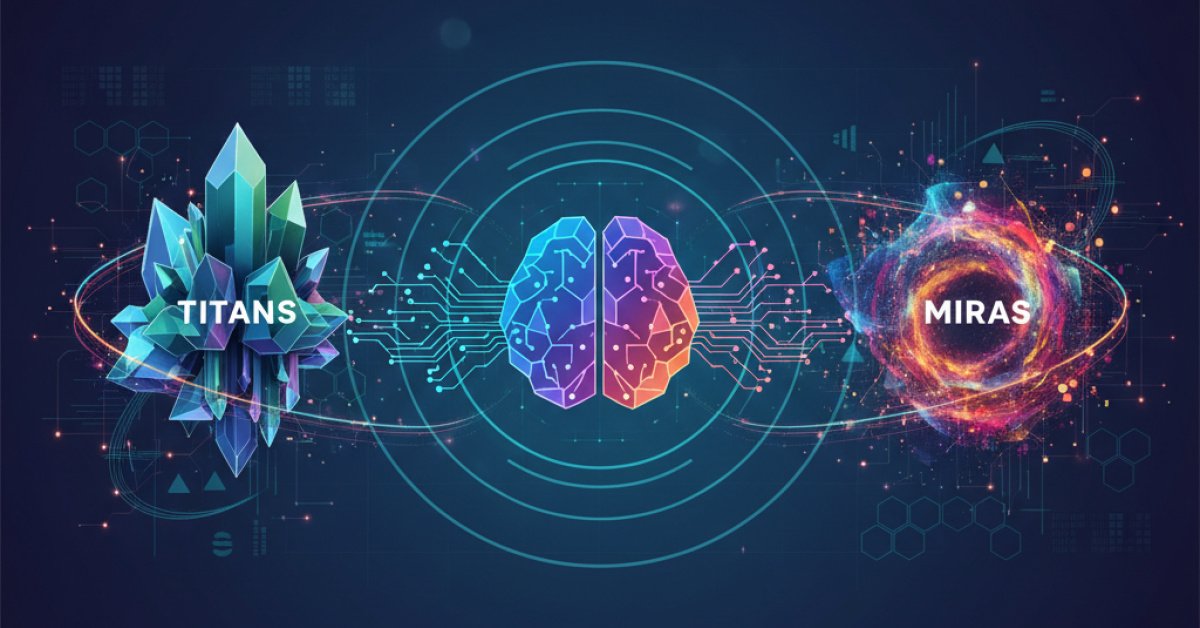
Well, it looks like a team at Google Research might have just cracked the code. They’ve introduced two new concepts, Titans and MIRAS, that completely rethink how AI models remember things. And honestly, it’s one of the most exciting developments I’ve seen in a while. It’s not just another bigger model; it’s a smarter one.
The Big Problem with AI Memory
So, let's break down why AI memory is so tricky.
For years, the gold standard has been the Transformer model. Its secret sauce is a mechanism called "attention," which lets the model look at every single word in its context window to figure out what's important. Think of it like having a photographic memory—it can see everything at once, which makes it incredibly powerful for understanding context. The problem? The more you put in that context window, the more work it has to do. The cost grows quadratically, which means doubling the text doesn't double the work; it quadruples it. It quickly becomes impossibly slow and expensive.
To get around this, a new wave of models like Mamba and other State Space Models (SSMs) came along. These are the efficient ones. Instead of looking at everything at once, they compress the past into a fixed-size "state." It’s like taking quick notes as you read. This is way faster and cheaper, but you can probably guess the downside: you lose information. Important details can get lost in the compression, especially over very, very long sequences.
So we’ve been stuck with a choice: a super-smart but expensive model with a limited memory, or a super-efficient model that can be a bit forgetful. What we really want is the best of both worlds.
And that’s exactly what Google’s Titans aims to deliver.
Meet Titans: An AI with Both Short-Term and Long-Term Memory
The idea behind Titans is surprisingly intuitive because it mirrors how our own brains work. We have a short-term, working memory for what's happening right now, and a separate long-term memory for important facts and experiences.
Titans does the same thing for an AI:
- Short-Term Memory: It uses the classic, powerful attention mechanism, but only on a recent "window" of text. This gives it that precise, in-the-moment understanding.
- Long-Term Memory: This is the new part. It adds a separate, deep neural network that acts as a persistent memory bank.
Here’s the clever bit. How does the AI decide what’s important enough to save to its long-term memory?
It uses something the researchers call a "surprise metric." As the model processes new information, it essentially asks itself, "Did I expect that?" If a token is predictable (like the word "day" after "have a nice..."), the model just moves on. But if it encounters something surprising—a key fact, a character's name, a critical piece of data—the model's internal "surprise" is high. This triggers it to store that information in its long-term memory.
It's not just storing it, either. It's actively learning and updating this memory as it goes, even during inference (when you're using it). It uses a form of gradient descent to fine-tune its memory, which also helps it "forget" less relevant information over time to make room for new, important stuff. And they figured out how to do all this in a way that’s still super fast and parallelizable on modern hardware.
So, Does It Actually Work?
In a word: yes. The results are pretty staggering.
On standard language benchmarks, Titans outperformed other state-of-the-art efficient models like Mamba-2. But where it truly shines is in extreme long-context tasks.
The researchers tested it on a benchmark called BABILong, which is designed to see if a model can find a needle in a haystack—a single fact hidden in an incredibly long document. Titans was able to handle context windows of over 2,000,000 tokens.
To put that in perspective, that’s the equivalent of reading Leo Tolstoy's War and Peace nearly four times over and still being able to recall a specific detail from the first few pages. On this task, Titans outperformed all other models, including giants like GPT-4, while using far fewer parameters. That's a huge deal. It’s getting better results with less computational muscle.
From a New Model to a New Framework: What is MIRAS?
Okay, so Titans is a specific, concrete architecture. But the Google team didn't stop there. They zoomed out and asked a bigger question: What if all these different approaches to AI memory—Transformers, RNNs, Titans—are just different recipes made from the same basic ingredients?
This led them to create MIRAS, which isn't a model but a unifying framework. Think of it as a "theory of everything" for sequence models.
MIRAS proposes that you can describe almost any sequence model by defining four key components:
- Memory Structure: What does the memory look like? Is it a simple vector, a matrix, or a complex neural network like in Titans?
- Attentional Bias: What does the model care about? This is the internal loss function that defines what it tries to remember (e.g., minimizing "surprise").
- Retention Gate: How does it forget things? This is the mechanism that keeps the memory from getting cluttered with useless information.
- Memory Algorithm: How does it update its memory? Is it a simple rule or a complex optimization process like gradient descent?
Using this lens, you can see that models like Mamba and Titans are just different combinations of these four choices. But the real power of MIRAS is that it gives researchers a playground. You can mix and match these components to invent entirely new types of models.
And that’s what they did. From the MIRAS framework, they created three new attention-free models—named Moneta, Yaad, and Memora—which also achieve top-tier performance on long-context tasks.
What This All Means for You and Me
This might all sound a bit academic, but the implications are massive. We're on the verge of having AI that can be a true partner in complex, information-heavy tasks.
Imagine an AI that can read an entire company's financial history to find patterns no human could spot. Or a medical AI that can analyze a patient's entire life-long health record to suggest a diagnosis. Or a programming assistant that understands your entire codebase, not just the file you have open.
This isn't just about making chatbots better at remembering your name. It's about fundamentally expanding the scale of problems AI can help us solve. By giving models a reliable, long-term memory, we’re taking a huge step toward AI that can reason, plan, and assist us on a whole new level. It's a shift from AI that processes information to AI that truly understands it over time. And that changes everything.