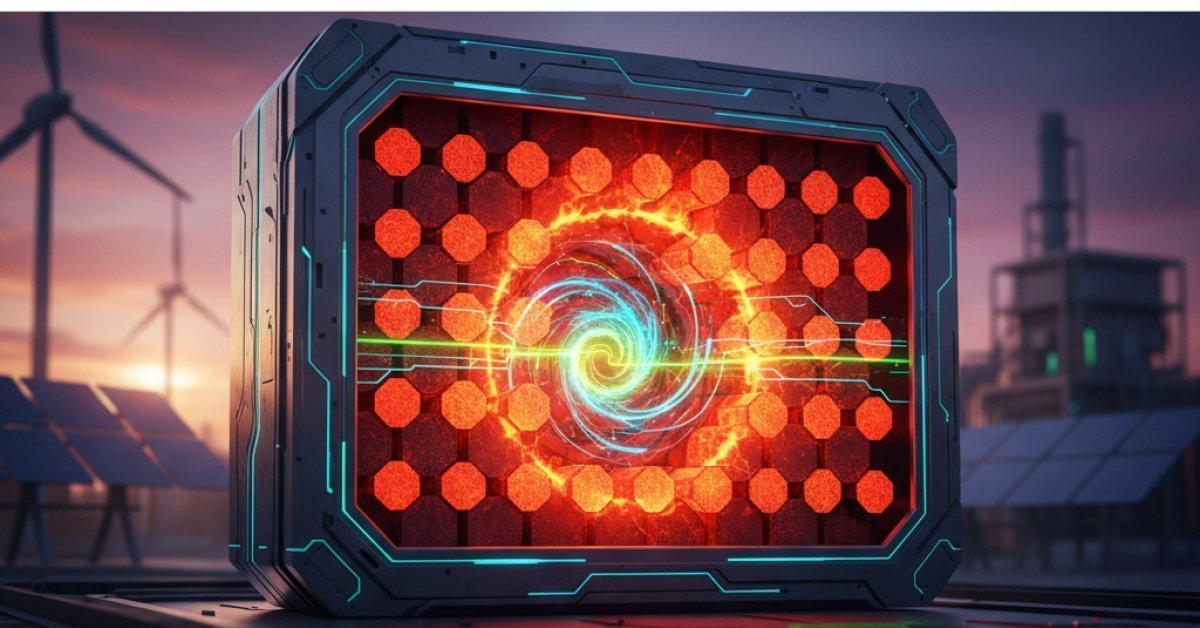
When you think of a battery, you probably picture the lithium-ion block in your phone or the massive packs in an electric car. But what if I told you the next big thing in energy storage looks more like a giant, high-tech pizza oven?
That's essentially what Rondo Energy just switched on in California. It's the world’s largest thermal battery, and it works on a brilliantly simple principle: use electricity to heat up a massive pile of bricks, then use that stored heat later. This first-of-its-kind system is now officially up and running, boasting a hefty 100 megawatt-hours of capacity.
This isn't just another lab experiment. It's a full-scale, real-world deployment that proves a new kind of energy storage is ready for the big leagues. Thermal batteries are poised to tackle one of the toughest, most overlooked parts of the climate puzzle: industrial heat. But this milestone comes with a spicy twist. Its first customer is using all that clean heat to get more oil out of the ground.
So, let's unpack what this "box of hot bricks" really is, why its first job is so controversial, and what it could mean for cleaning up our planet's heaviest industries.
What in the World is a Thermal Battery?
Forget complex chemistry and rare earth metals. The concept behind a thermal battery is something you can grasp intuitively.
Imagine using cheap, abundant solar power during the day to run a massive toaster, but instead of bread, you're heating up specially designed bricks to scorching temperatures. Rondo's system heats its brick core to over 1,000 °C (that’s about 1,800 °F). The bricks, made from common and inexpensive materials, can hold that intense heat for hours or even days with very little loss.
When a factory needs steam or hot air for a process, instead of burning natural gas, it just taps into the battery. Air is blown through the hot brick core, creating a super-heated blast that can be used directly for manufacturing or to generate steam.
The Numbers That Matter
What makes Rondo's achievement so significant isn't just the idea, but the execution. Here’s a quick look at the specs:
- Capacity: 100 MWh. To put that in perspective, this is a 50x leap from the 2 MWh pilot system they started up just last year.
- Efficiency: The system is incredibly efficient, returning over 97% of the electrical energy put into it as useful heat. That's a stunningly low level of energy loss.
- Power Source: This particular battery is powered by its own dedicated, off-grid solar array, making the heat it produces genuinely zero-carbon.
For the past 10 weeks, this system has been humming along, hitting all its performance targets. It’s no longer a blueprint or a prototype; it's a proven, commercial-scale piece of hardware.
The Elephant in the Room: Powering Big Oil
Okay, so we have this incredible green technology that uses solar power to create clean heat. It’s a climate champion's dream, right? Well, here’s the complicated part. The first commercial application for this massive thermal battery is in "enhanced oil recovery" (EOR).
In simple terms, EOR involves injecting high-pressure steam deep into oil wells to loosen up and extract stubborn crude oil that would otherwise be left in the ground. Traditionally, this process requires burning enormous amounts of natural gas to create that steam. Rondo's battery provides a solar-powered alternative.
This immediately sparks a debate. Is it a good thing to help a fossil fuel company reduce its operational emissions? Or does this just make oil extraction cleaner and more profitable, thereby prolonging our reliance on the very fuels we need to abandon?
Critics argue that technologies like this effectively greenwash fossil fuel operations, keeping polluting infrastructure running longer. It's a valid and tricky point for any climate tech company to navigate.
Rondo's Pragmatic Defense
When asked about this choice, Rondo's founder and chief innovation officer, John O’Donnell, offered a pragmatic perspective. “We are decarbonizing the world as it is today,” he said.
His argument is that as long as these oil operations exist, it's better to help them clean up their act than to let them continue burning gas. For the customer, the math made sense. A perfect storm of cheap solar power, volatile natural gas prices, and California's climate policies created a clear business case for switching to Rondo's heat battery.
Having a paying customer willing to fund a full-scale system was crucial for Rondo. It allowed them to prove their technology works in the field, not just on a spreadsheet. This real-world validation is invaluable for attracting future customers in other industries.
Why Industrial Heat is the Climate's $6 Trillion Problem
While the oil and gas connection is grabbing headlines, it's crucial to understand the bigger prize Rondo and its competitors are chasing. A staggering 20% of all global energy demand is used to generate heat for industrial processes.
Think about what it takes to make things like:
- Cement: Requires heating kilns to over 1,400°C.
- Steel: Needs massive amounts of heat for melting and forging.
- Food Processing: Relies on steam for pasteurization and cooking.
- Chemicals & Plastics: Manufacturing these materials is incredibly heat-intensive.
Today, the vast majority of that heat comes from one source: burning fossil fuels. This makes heavy industry one of the hardest-to-decarbonize sectors of our economy. You can't just plug a giant steel furnace into a standard electrical grid.
This is where thermal batteries come in. They act as a bridge, allowing industries to soak up cheap, intermittent renewable energy (like solar and wind) and convert it into the steady, high-temperature heat they need to run their operations 24/7. It's a direct replacement for the fossil fuels they're burning today.
As O'Donnell puts it, "This is a really dumb, practical thing that’s ready now." And sometimes, the simplest solutions are the most powerful.
So, What’s Next for the Hot Brick Revolution?
This first 100 MWh battery is just the beginning. The real test of any new technology is its ability to scale quickly and affordably.
Rondo is already building three more full-scale units in Europe, and the lessons learned from the California project are expected to make those deployments cheaper and faster. The company isn't waiting around for orders, either. Its factory in Thailand already has the capacity to churn out 2.4 gigawatt-hours' worth of heat batteries every year. That's enough to make a serious dent in industrial emissions.
It's easy to feel conflicted about a climate solution getting its start by helping an oil company. We absolutely need to transition away from fossil fuels as quickly as possible. But there's also a powerful argument to be made for pragmatism. As long as these industrial operations exist, there's immense value in cleaning them up.
Ultimately, the success of this project isn't just about one battery. It’s a powerful proof point. For years, thermal energy storage has been a promising idea on a PowerPoint slide. Now, it's a real, steel-and-brick reality, proving it can stand up to the rigors of heavy industry. And for sectors like cement and steel that have been desperately searching for a path away from fossil fuels, that's a very big deal. The hot brick revolution is officially here.