Remember a couple of years ago? It felt like every single day brought a new, mind-blowing AI announcement. We saw AI create stunning art from a simple sentence, write code, and even pass the bar exam. It was an exhilarating, dizzying time. Tech leaders were on stage, making grand promises about Artificial General Intelligence (AGI) being just around the corner, ready to solve all of humanity's problems.
It felt like we were living in the future.
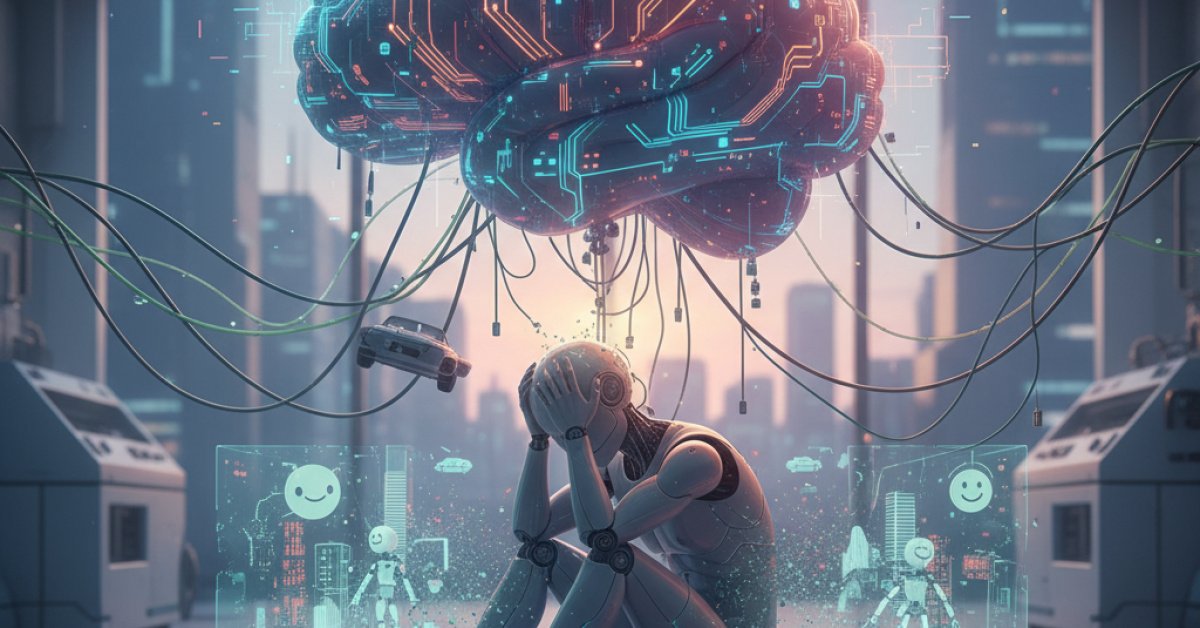
But as we've moved into 2025, the air has changed. The breathless headlines have been replaced by more cautious ones. The big promises from the top brass at major AI labs haven't quite materialized on schedule. And if you're feeling a little bit of whiplash, you're not alone. What we're seeing is a classic, and frankly, a necessary part of any major technological shift: the great hype correction.
This isn't about AI being a failure. Far from it. It's about us, as an industry and as a society, collectively taking a deep breath and moving from the "magic show" phase to the "okay, how do we actually make this work in the real world?" phase. Let's break down what this reality check really looks like.
First Off, Large Language Models Aren't the Whole Story
When most people think of "AI" right now, they're probably picturing ChatGPT or a similar chatbot. These Large Language Models (LLMs) are incredible, no doubt. They’re the charismatic star quarterback that gets all the media attention. They can write, summarize, and brainstorm in ways that feel like magic.
But here’s the thing: you can't win a championship with just a quarterback.
LLMs are just one piece of the vast AI puzzle. There are so many other powerful types of AI working behind the scenes that are just as important. Think about computer vision, the technology that allows a self-driving car to see a pedestrian, or the AI in your phone that recognizes your face. Or reinforcement learning, which can train a robot to perform complex physical tasks.
The real breakthroughs, the ones that will truly change industries, rarely come from a single LLM. They come from combining different AI techniques. Imagine a system for doctors that uses computer vision to analyze an MRI, a predictive model to assess risk factors, and then an LLM to summarize the findings in plain English. That’s where the real power is. We got so fixated on the flashy chatbot that we forgot about the rest of the team.
So, Why Isn't AI Fixing Everything Yet?
If the tech is so powerful, why isn't it seamlessly integrated into every part of our lives, solving all our problems like we were promised? Because a powerful tool is only as good as the person and the process wielding it.
Think of it like this: buying a professional-grade, top-of-the-line kitchen oven doesn't instantly make you a Michelin-star chef. You still need quality ingredients, a solid recipe, and the skill to actually cook the meal.
It’s the exact same with AI. Companies rushed to buy the "AI oven" and are now discovering the hard parts:
- The Ingredients (Data): Most companies' data is a mess. It's siloed, inconsistent, and often incomplete. You can't train a world-class AI on junk data.
- The Recipe (Strategy): You can't just "sprinkle some AI" on a broken business process and expect it to work. You need a clear plan for what problem you're trying to solve and how AI fits into that solution.
- The Skills (Talent): There's a massive shortage of people who truly understand how to build, integrate, and maintain these complex systems.
AI isn't a magic wand you can wave to fix deep-seated organizational problems. It's a powerful, but difficult, tool that requires hard work, significant investment, and a total rethinking of how things are done. That's the boring, unglamorous truth that's finally coming to light.
Are We in an AI Bubble? And What Happens if It Pops?
Okay, let's just say it: it sure feels like we've been in a bubble. The sky-high valuations for startups with no product, the billions of dollars being thrown around—it has all the hallmarks. But is it the same as the dot-com bubble of the late '90s?
Yes and no. It’s a bubble, but I believe it's a different kind of bubble.
During the dot-com crash, companies like Pets.com went bust spectacularly. But the underlying technology—the internet—wasn't a fad. It was real, and it went on to change the world. The bubble was in the irrational business models, not the core technology.
I think that's where we are with AI. The technology itself is profoundly real and transformative. The bubble is more of an "expectation bubble." We expected too much, too soon. The correction we're seeing isn't AI disappearing; it's a painful but healthy process of weeding out the hype from the reality.
So what happens when this bubble fully "corrects"? We'll likely see a consolidation. The companies built on pure hype will fade away. The ones with real, paying customers and sustainable business models will survive and get stronger. Investment will become more discerning, flowing toward practical applications instead of sci-fi dreams. It's the end of the party, but it's the beginning of the actual, long-term construction project.
ChatGPT Wasn't the Beginning, and It Won't Be the End
It’s easy to think the AI story started in late 2022 when ChatGPT burst onto the scene. But that was just the moment the public at large woke up to it. For the researchers and engineers in the field, it was the result of decades of slow, steady work. ChatGPT wasn't Day One; it was a "Sputnik moment"—a highly visible achievement that captured the world's imagination and kicked off a new race.
So, what comes next? Where do we go after the hype?
The future of AI is probably less about a single, god-like AGI and more about a diverse ecosystem of specialized, efficient, and reliable AI tools. We're already seeing a shift away from the "bigger is always better" mindset of building gargantuan models. The focus is turning to smaller, more nimble models that can run on your phone or laptop, tailored for specific tasks.
Ultimately, the goal is for AI to become like electricity. It's a fundamental, world-changing technology that is so deeply integrated into everything we do that we stop even noticing it's there. It won't be a single chatbot we talk to; it will be the invisible intelligence that makes our software smarter, our medical diagnoses more accurate, and our daily lives a little bit easier.
This hype correction might feel like a disappointment, but it’s actually the most exciting part. The magic show is over, and now the real work of building that future can finally begin.