Let’s try a little thought experiment.
Imagine you’re a machine learning engineer at a company like Apple or Fitbit. You have access to a potential goldmine of data from millions of smartwatches: heart rates, sleep patterns, daily steps, workout logs... you name it. Your goal is to build a groundbreaking AI model that can predict potential health risks or suggest the perfect workout for each person.
There’s just one massive problem. Privacy.
Laws like GDPR and HIPAA are crystal clear: you absolutely cannot pull that sensitive, personal health data off a user’s device and store it on your central servers. It has to stay private, locked away on their phone or watch. So, how in the world do you train a massive AI model without any data to train it on?
It sounds completely impossible, right? But here’s the secret: instead of bringing all the data to the model, you bring the model to the data.
This is the brilliant idea behind a technique called Federated Learning. It allows us to build incredibly smart AI systems that learn from our collective experiences without ever compromising our individual privacy.
So, What Exactly is Federated Learning?
Alright, let's break it down. Think of it like a group of expert chefs all trying to create the world's best new recipe.
In the old way of doing things (centralized machine learning), you'd have to collect every single chef's secret ingredients and private notes, bring them all to a central kitchen, and try to figure out the recipe there. It’s effective, but it means everyone has to share their secrets.
Federated learning flips that script entirely.
Instead, a "master recipe" (the AI model) is sent out to each individual chef's kitchen. Each chef tinkers with the recipe locally, using their own private ingredients and techniques. They see what works and what doesn't.
But here’s the key part: they don't send their ingredients back. They only send back their learnings. Things like, "Adding a bit more spice worked well," or "This cooking time was too short."
These little updates—not the raw data—are sent back to the central kitchen. The head chef then intelligently combines all these suggestions to improve the master recipe. This new, improved recipe is then sent back out, and the whole process repeats.
Over time, the master recipe becomes incredible, benefiting from the experience of thousands of chefs, but no one ever had to reveal their secret family ingredients.
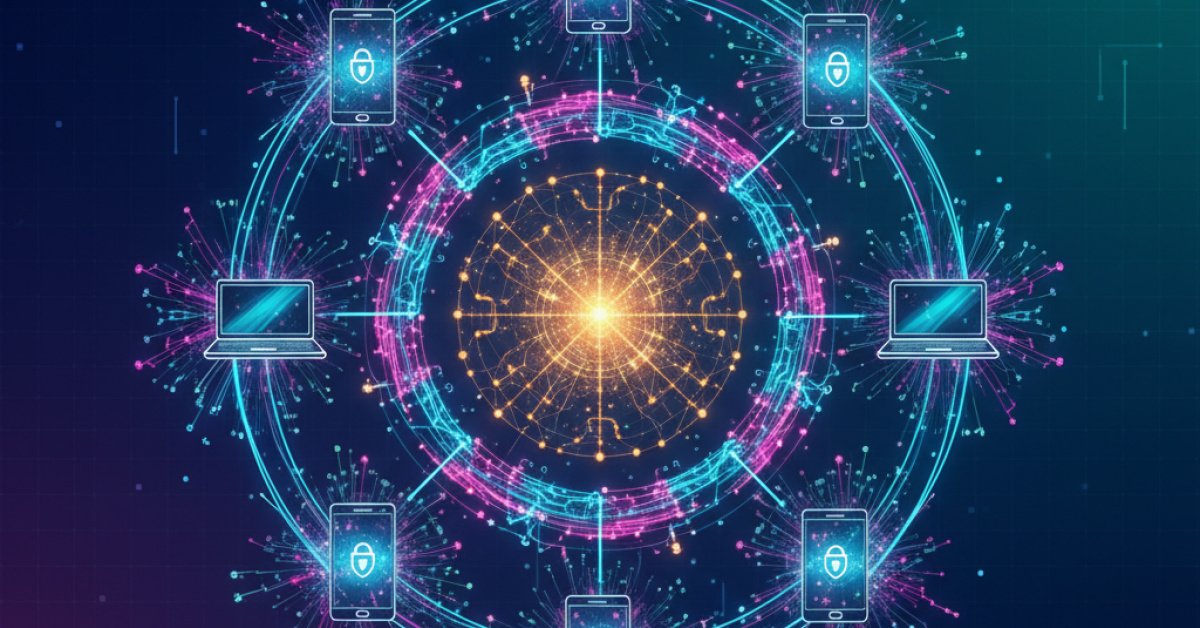
That’s federated learning in a nutshell. The model trains right on your device, using your data, but only the anonymous, mathematical "lessons" it learned are sent back to improve the global model. Your photos, messages, and health data never leave your phone.
A Quick Peek at the Different Flavors
Just like with any tech, there isn't a one-size-fits-all approach. Federated learning comes in a few different styles:
- Centralized FL: This is the classic model we just described. A central server acts as the coordinator, sending out the model and gathering the updates. Think of it as the "head chef" in our analogy.
- Decentralized FL: This one’s a bit more like a collaborative potluck. Instead of a central server, devices share their updates directly with each other. This is great because there’s no single point of failure.
- Heterogeneous FL: This version is designed for the real world, where we’re all using different devices. It acknowledges that your powerful new smartphone has way more processing power than, say, a simple IoT sensor or an older smartwatch, and it adjusts the training process accordingly.
Okay, But It Can’t Be That Simple, Right?
You’re right. While the concept is elegant, making it work in the real world is a massive engineering challenge. It’s not as simple as just zapping a model to millions of phones and hoping for the best.
Here are some of the hurdles that engineers have to overcome every day.
1. Our Poor, Overworked Devices
Your phone or smartwatch isn't a supercomputer sitting in a data center. It has limited processing power, not a lot of memory, and most importantly, it runs on a battery.
Training an AI model, even a small one, takes energy. You can't just have this process running in the background, draining someone's battery while they're trying to navigate with Google Maps. So, training has to be incredibly lightweight and smart. It usually only happens when a device is idle, charging, and connected to Wi-Fi, which brings us to the next problem.
2. Herding a Million Cats (Client Availability)
At any given moment, most devices are not available for training. They might be turned off, in a user's pocket with the screen locked, low on battery, or on a spotty cellular connection.
This means you’re working with a constantly changing, unpredictable fleet of devices. You can’t rely on everyone to participate, so the system has to be incredibly resilient and able to work with whatever devices happen to be available at that moment.
3. Everyone’s Data is Weird and Different
In a traditional data center, you have a nice, clean, well-organized dataset. With federated learning, you’re dealing with the beautiful chaos of human life.
My fitness data is completely different from yours. You might be a marathon runner, while I prefer yoga. Our sleep schedules are probably worlds apart. This is what data scientists call "non-IID" (Not Independent and Identically Distributed) data.
This "skewed" data makes it much harder for the global model to learn. If the model only learns from a small group of super-athletes, it won't be very useful for the average person. The aggregation process has to be smart enough to balance out these biases and find patterns that are truly universal.
4. Don’t Hog the Wi-Fi
Sending model updates back and forth can use a lot of bandwidth. If not handled carefully, it could slow down a user's internet connection or eat into their mobile data plan. To get around this, engineers use clever compression techniques and methods that only send the most important parts of the model update, keeping the data packages as small as possible.
5. Keeping the "Learnings" Secure
Finally, even though we're not sending raw data, we still have to be incredibly careful. A clever attacker could potentially try to reverse-engineer the model updates to guess at the underlying data.
To prevent this, all communication is encrypted. On top of that, techniques like secure aggregation and differential privacy are often used. Think of differential privacy as adding a tiny bit of statistical "noise" to the updates. This noise is small enough that it doesn't hurt the model's performance, but it’s just enough to make it mathematically impossible to figure out any specific individual's information.
It’s a tricky balancing act, for sure. But this privacy-first approach is becoming more and more essential. It’s the key to building AI that is both incredibly helpful and deeply respectful of our personal boundaries. And in a world where data privacy is more important than ever, that’s a future I think we can all get excited about.