It sounds like something straight out of a science fiction novel.
Imagine the very first, most mysterious moment of pregnancy. A tiny, ball-shaped embryo nestles into the wall of the uterus, preparing to grow. This is implantation, the critical step where a potential life truly takes hold. For decades, this entire process has been a black box, hidden away from sight.
Well, not anymore.
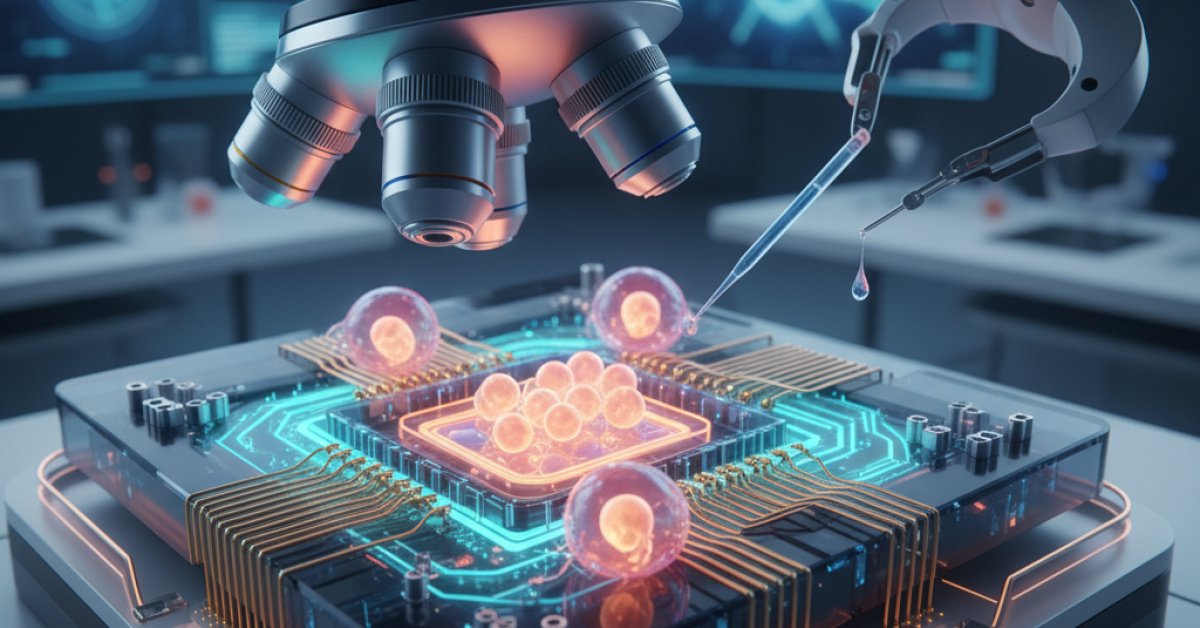
In a few labs across the world, scientists are watching this exact scene play out… on a tiny, transparent chip. They’ve managed to create what are essentially "mini-uteri" in the lab and are getting real human embryos to implant into them. It's a breakthrough that is both incredible and a little bit mind-bending, and it could change everything we know about the start of human life.
So, What's Actually Going On Here?
Okay, let's break this down. In three major papers that just dropped, teams from China, the UK, Spain, and the US have all reported on their success with this new technique.
Here’s the basic recipe:
- You start with an "organoid." This is the cool part. Scientists take endometrial cells—the cells that make up the lining of the uterus—and coax them into growing into a 3D structure. Think of it less like a flat layer of cells in a petri dish and more like a tiny, self-organizing ball of tissue that acts like a miniature uterine lining.
- Then you introduce an embryo. These are real human embryos, donated from IVF centers, that are just a few days old (at a stage called a blastocyst).
- You watch what happens. The researchers place the organoid and the embryo together inside a microfluidic chip, which is just a fancy name for a small device with tiny channels for nutrients. Then, they watch and record as the embryo attaches and begins to burrow into the organoid, just like it would in a real pregnancy.
"You have an embryo and the endometrial organoid together," explains Jun Wu, a biologist at UT Southwestern who worked on two of the studies. "That’s the overarching message of all three papers."
And for the first time, we have a front-row seat to the entire process. Hongmei Wang, a developmental biologist in Beijing, usually has to study monkeys to get a glimpse of this stage. "We’ve always hoped to understand human embryo implantation, but we have lacked a way to do so," she says. "It’s all happening in the uterus."
Now, it's happening on a chip.
Why This Could Be a Game-Changer for IVF
If you've ever known anyone who has gone through IVF, you know how emotionally and financially draining it can be. And one of the most heartbreaking parts is when it doesn't work. A common failure point is implantation—the embryo, for whatever reason, just doesn't attach to the uterus.
This new research aims to figure out why.
"Considering that implantation is a barrier [to pregnancy], we have the potential to increase the success rate if we can model it in the laboratory," says Matteo Molè, a biologist at Stanford involved in one of the papers.
Think of it like this: if you’re trying to figure out why a key isn't opening a lock, you need to be able to see the key and the lock up close. This technology finally lets scientists see that "click" between the embryo and the uterus.
To get around the ethical and practical challenges of using real human embryos for every single experiment, the teams also used something called "blastoids." These are artificial embryos made from stem cells. They mimic the real thing so well that they can be used for large-scale testing, helping researchers understand what a healthy implantation looks like. Leqian Yu, a senior author on one of the Beijing reports, said the obvious next step after creating blastoids was to see if they could implant. This new system was the answer.
Of course, there are rules. All of these experiments are stopped at or before the 14-day mark, a long-standing ethical guideline in regenerative medicine. But even that two-week window is providing a flood of new information.
From the Lab to Your Doctor's Office?
This isn't just a cool science experiment; it's already moving toward real-world applications.
At least two startups, Dawn Bio and Simbryo Technologies, are commercializing similar systems. The idea is to offer "personalized" predictions for IVF patients. A doctor could take a small biopsy of a patient's uterine lining, grow an organoid from it in the lab, and then test how well blastoids implant into it.
If they don't attach, it could be a sign that the patient's uterus isn't "receptive," pointing to the root cause of their IVF failures. It’s a way to test the "soil" before you plant the "seed," so to speak.
The Beijing team is taking it a step further. They used their system to screen for drugs that might help with implantation. They created organoids from women who had experienced repeated IVF failures and tested over 1,000 approved drugs on them.
And they found something. One chemical, avobenzone—an ingredient found in some sunscreens, of all things—seemed to help. It boosted the chances of a blastoid implanting from a measly 5% to around 25%. It's still early days, but they're hoping this could lead to a clinical trial for a drug that could genuinely help people get pregnant.
This All Leads to a Bigger Question: Are We Building Artificial Wombs?
Look, it's impossible to talk about this without your mind jumping to the sci-fi implications. If we can start a pregnancy in a lab, how far can we take it?
Let's be clear: what the scientists have built is a long, long way from a full artificial womb. The current organoid system is pretty basic. It’s missing crucial components like immune cells and, most importantly, a blood supply.
But they're working on it.
Leqian Yu says his team is already trying to add blood vessels and tiny pumps to the chip to create a rudimentary circulation system. This would allow them to grow the embryos and blastoids for longer, pushing the boundaries of what's possible.
This technology is absolutely a step toward what's known as "ectogenesis," or developing a baby entirely outside the body. Jun Wu acknowledges this but urges caution. "I think this technology does raise the possibility of growing things longer," he says. "But I don’t think it’s anywhere near an artificial womb. That’s still science fiction."
For now, at least.
What we're seeing is the very first chapter of a story that is going to have profound implications for medicine, ethics, and our very definition of how life begins. We've opened the black box, and we're just starting to understand what's inside.