It feels like we’re living in a weird, contradictory chapter of the AI story. On one hand, we’re told this technology is the future, a revolutionary force set to change everything. On the other, we see whispers of failed projects and hear tech leaders draw strange lines in the sand about what AI should and shouldn’t be. It’s a fascinating, and frankly, confusing time.
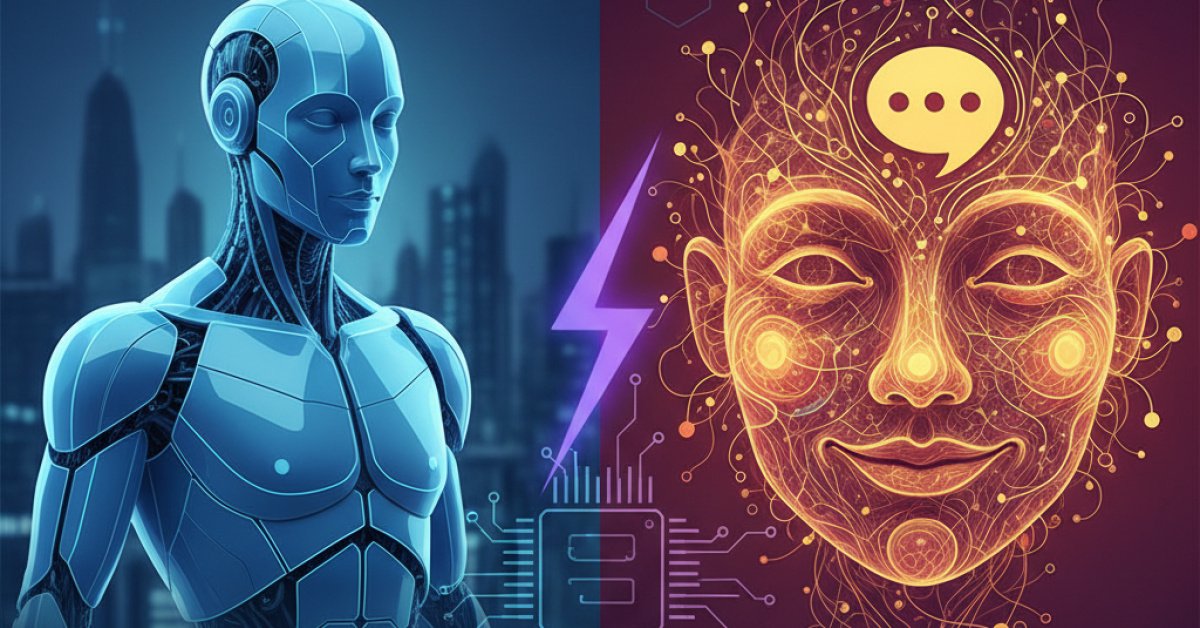
The perfect example of this tension comes straight from the top at Microsoft AI. Its CEO, Mustafa Suleyman, is trying to navigate a minefield. He’s sounding the alarm about AI chatbots becoming too human, while simultaneously pushing his own products to be more… well, human.
At the same time, the broader industry narrative is just as muddled. After years of relentless hype, we’ve seen a few cracks appear in the AI facade. But is anyone actually slowing down? Or are we all just pretending the party’s still going at full blast, even if the music has gotten a little weird? Let’s unpack this AI paradox.
The Fine Line: Microsoft's "No Sexbots" Rule vs. "Expressive" AI
"We will never build a sex robot." That's not a line from a sci-fi movie; it's a direct quote from Mustafa Suleyman, the head of Microsoft AI. It’s a bold statement, and his reasoning gets to the heart of a growing anxiety in the tech world.
Suleyman worries that the industry is barreling toward a dangerous future by designing chatbots that are indistinguishable from people. His concern is that users will be emotionally manipulated, tricked into seeing genuine life and consciousness where there’s only sophisticated, lifelike programming. It’s a valid fear—we’re already seeing people form deep, complex relationships with their AI companions.
But here’s where things get complicated. Just last week, Microsoft rolled out a series of updates for its own AI, Copilot. The goal? To make it more "expressive, engaging, and helpful." See the contradiction? It’s a classic case of trying to have your cake and eat it too. The company is actively working to make its AI feel more personal and intuitive, which is exactly the path that leads to the very blurring of lines Suleyman claims to be worried about.
This isn’t just a Microsoft problem; it’s an industry-wide tightrope walk. To compete, AI products need to be engaging. They need to connect with users on a more natural, human level. Yet, the more successful they are at this, the closer they get to that ethical red line. It leaves us all wondering what the ultimate vision is for our relationship with this technology. Are AIs meant to be sterile tools or are they destined to become our friends, confidantes, and collaborators? Microsoft, it seems, is still figuring that out.
The Great AI Slowdown That Wasn't: Is the Hype Bubble Popping in Secret?
A few weeks ago, it felt like the AI hype train might finally be losing some steam. The release of GPT-5 in August was met with a collective "meh" from many corners of the tech community—it was an incremental improvement, not the earth-shattering leap some had expected.
Then came a bombshell report claiming that a staggering 95% of generative AI pilot programs were failing to deliver. The news sent a brief shiver through the stock market. This seemed like the perfect moment to ask the big question: Which companies are getting cold feet and scaling back their massive AI investments?
Our senior AI reporter, James O’Donnell, went on this exact quest, expecting to find a trail of cautious CFOs and disappointed tech leads. What he found was… nothing. Complete radio silence. Despite the negative headlines, not a single company was willing to go on the record about scaling back their AI ambitions.
So, what do we make of this failed quest? There are a few possibilities:
- The failures are real, but the shame is greater. No company wants to be the one to admit they poured millions into a futuristic AI project that ended up going nowhere. It’s easier to fail in silence and keep up appearances.
- The long-term vision is unshaken. Many leaders might see these early failures as bumps in the road, not a dead end. They’re willing to absorb the losses because they still believe AI is the ultimate destination.
- The reports of failure are overblown. It’s also possible that while many pilots fail, the successful ones are so successful that they justify all the other experiments.
Whatever the reason, there's a clear disconnect between the private reality of AI implementation and the public narrative. The hype might not be as invincible as it seems, but for now, nobody is brave enough to say the emperor has no clothes.
AI on the Ground: From Mental Health Support to Musk's Wikipedia
Beyond the high-level corporate drama, AI is making its presence felt in some very real, and often strange, ways across the web. Here’s a look at what’s been happening.
The Human Cost of AI Companionship
The lines between tool and therapist are getting blurrier. OpenAI estimates that hundreds of thousands of ChatGPT users are exhibiting symptoms of severe mental health distress in their conversations. In response, they’ve tweaked GPT-5 to respond more effectively to users in crisis.
However, they’ve drawn a line at forcing users to take a break, refusing to lock access even for those in distress. This has reignited the debate over whether an AI should have the right to "hang up" on a user for their own good—a complex ethical question with no easy answers.
The Battle for Information
Never one to sit on the sidelines, Elon Musk has launched his own AI-generated answer to Wikipedia, dubbed "Grokipedia." Unsurprisingly, its entries tend to reflect the billionaire’s right-leaning worldview. Reports have already surfaced of pages that perpetuate historical inaccuracies and conservative talking points.
It’s a powerful reminder of what Ryan McGrady, a research fellow at the University of Massachusetts Amherst, said: "The impulse to control knowledge is as old as knowledge itself. Controlling what gets written is a way to gain or keep power." Musk’s project isn’t just about information; it’s about shaping a narrative.
When Worlds Collide: Tech, Biology, and Society
The fusion of technology with our physical and cultural worlds continues to accelerate in mind-bending ways:
- Medical Miracles: In a stunning medical achievement, surgeons successfully removed a genetically engineered pig kidney from a living patient after it had functioned for the longest duration to date. It's a massive step forward in the quest for organ transplantation.
- Rebuilding a Life: A British cyclist, Dave Richards, who suffered severe third-degree burns, has been given a new, 3D-printed face, showcasing how technology can restore not just function, but identity.
- Virtual Superstars: In the metaverse, you don’t need to be human to be a K-pop idol. Virtual performers are gathering huge followings online before making the leap to real-world fame, completely changing what it means to be a celebrity.
A Cautionary Tale from Amsterdam: When "Fair AI" Fails
If you want a sobering reality check on the challenges of building ethical AI, look no further than Amsterdam. City officials in the welfare department embarked on an ambitious project with the noblest of intentions: to build an AI system that could prevent fraud while rigorously protecting citizens’ rights.
They did everything by the book. They invested huge amounts of time and money, and they followed all the emerging best practices for creating fair and transparent algorithms. They eventually launched a pilot program that processed live welfare applications.
The result? The system they’d so carefully built was still not fair and effective. Despite their best efforts, the AI perpetuated biases and failed to achieve its goals without creating unintended negative consequences for the very people it was meant to serve. An in-depth investigation by Lighthouse Reports, MIT Technology Review, and the Dutch newspaper Trouw dug into the system's code and found that the dream of a perfectly "fair" AI remains incredibly elusive. It's a powerful cautionary tale that shows just how hard it is to translate good intentions into good technological outcomes.
Quick Bytes: Layoffs, Domain Changes, and Ghostly Posts
The tech world never sleeps, and there’s always a flurry of other news to keep up with. Here’s a quick rundown of other important stories making waves:
- Amazon Layoffs Continue: Amazon is reportedly planning to cut up to 30,000 corporate jobs, partly driven by a reluctance from staff to return to the office full-time. Another round of layoffs is also expected in January.
- Farewell, twitter.com: The iconic domain is officially being shut down. If you still have an account, you'll need to re-enroll your security keys before the switch-off. This could also mean that millions of abandoned accounts might be sold off.
- Threads' Fleeting Thoughts: The social network Threads is testing "ghost posts" that will automatically disappear after 24 hours—if anyone even sees them in the first place.
- What is a Moon, Anyway? Believe it or not, astronomers don’t have an official, universally agreed-upon definition of a moon. This philosophical debate has been reignited by the discovery of a "quasi-moon" hovering near Earth.
- Seniors Embrace Screens: It’s not just teens glued to their devices. A new study shows that older people are embracing screens at a record pace, with digital habits that now mirror those of their grandchildren.
Finding the Fun in the Chaos
Reading through all this, it’s easy to get lost in the high-stakes drama of it all—the ethical dilemmas, the corporate posturing, the relentless pace of change. It can be a bit overwhelming. But it’s also important to remember that the world of technology is still a place of fun, absurdity, and genuine human creativity.
So, let's end on a lighter note. Let's celebrate Bill Gates' 70th birthday by remembering his surprisingly athletic chair-jumping skills. Let's collectively demand the return of Guitar Hero, the game that gave us all five minutes of rock-and-roll glory. And let's spare a thought for the medieval frogs who, according to historians, have been unfairly maligned for centuries.
From ghostly hauntings in London's fanciest neighborhoods to the philosophical debate over what makes a moon a moon, our world is a wonderfully weird place. And as we navigate the complex future that AI and technology are building, it’s good to hold on to that sense of wonder and, every once in a while, just have a good laugh.